

Your launch date can shape your first month on Airbnb. If the new-listing bump lasts only 2 to 4 weeks, going live at the wrong time can waste it.
Here’s the short answer: launch 4 to 8 weeks before your market’s busy stretch, open your calendar early, and match your go-live day to how guests in your area tend to book. In many U.S. markets, spring gives you a good runway before summer. But that changes by city. Scottsdale usually works best from October to March, while Pittsburgh often works best in spring, early summer, or early fall.
What matters most:
- Season: launch while demand is moving up, not after it peaks
- Lead time: many guests book 30 to 90 days ahead
- Day of week: midweek often fits urban and event markets; weekends can fit leisure markets
- Market type: Scottsdale is more seasonal; Pittsburgh is more event-led
- Early traction: first bookings and reviews matter a lot for search placement, often driven by professional Airbnb interior design and staging
A few simple takeaways:
- In Scottsdale, AZ, late winter and early spring can bring top rates, with peak pricing often 40% to 60% above baseline
- In Pittsburgh, PA, summer tends to be stronger, with hotel occupancy up about 17% from June through September
- In many cases, opening at 5% to 10% below your target rate at first can help get those first stays booked
- If you want holiday or peak-event bookings, your listing often needs to be live well before those dates
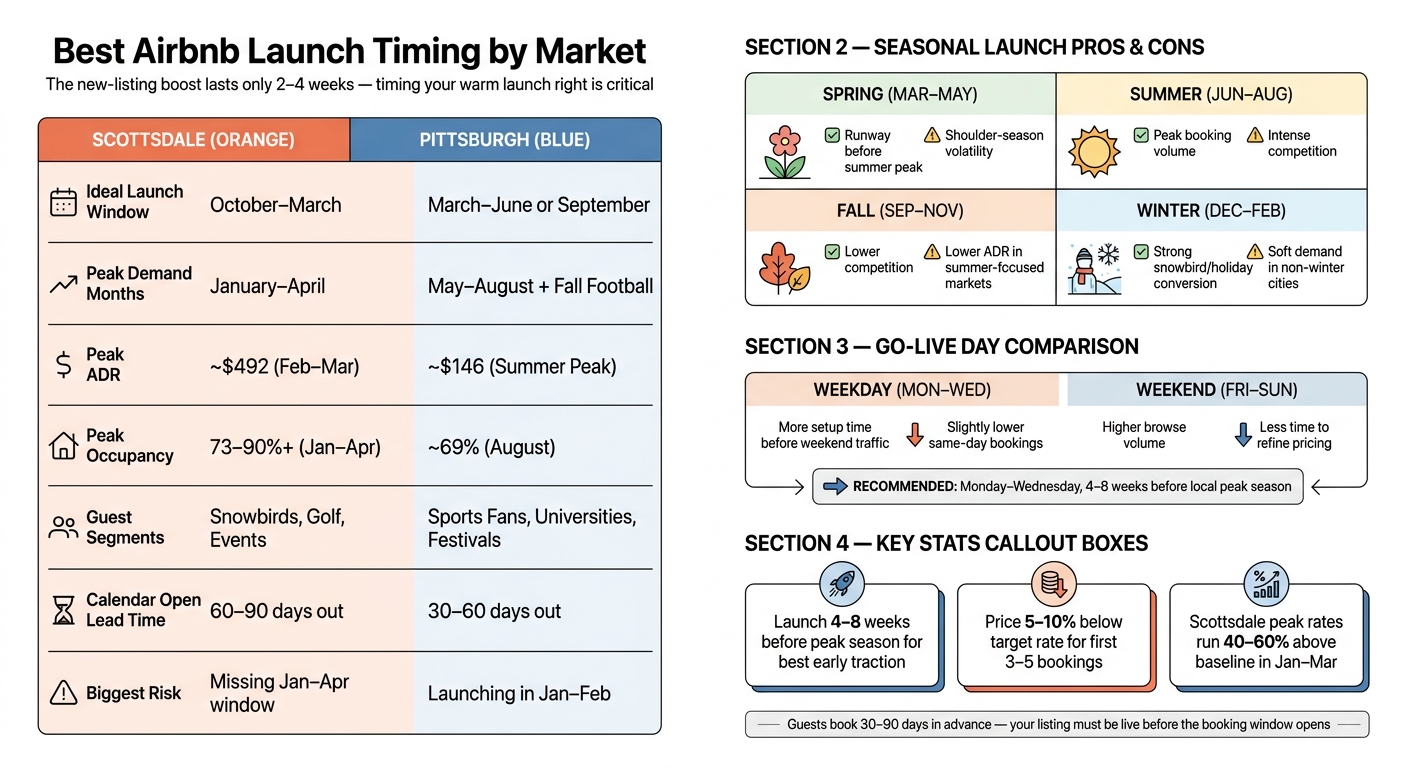
Airbnb Launch Timing by Market: Scottsdale vs Pittsburgh Cheat Sheet
A Successful Airbnb Launch Strategy: Fully booked
sbb-itb-103bddb
Quick Comparison
| Market | Best launch window | Peak demand | Best go-live timing |
|---|---|---|---|
| Scottsdale | October–March | January–April | Earlier launch, often before snowbird and event demand |
| Pittsburgh | March–June or September | May–August plus football weekends | Launch closer to events and summer demand |
Bottom line: if I wanted the best shot at early bookings, I’d launch before the rush, not during it. The article below breaks down how that changes by season, weekday, and market.
Spring Launch Window
Spring is a strong time to launch in many U.S. markets. Occupancy tends to climb through spring and hit its high point in July and August [14][11]. That gives a March or April launch a nice head start: you can pick up early bookings and collect reviews before summer demand hits full speed.
Booking Momentum and Lead-Time Alignment
Spring works well because demand is already moving up, and those first stays can help build review history. A common play is to price the first few bookings about 5% to 10% below your target rate. That can help fill the calendar faster and get reviews on the board.
A late-February or early-March launch can still catch April and May demand, especially if you open the calendar 90+ days in advance [12][13]. After that, the better go-live date often comes down to local events. In some places, March gives you the stronger ramp. In others, April lines up better with booking patterns.
Market Demand Fit
The same spring window won’t perform the same way in every market.
In Scottsdale, March is usually the best launch month. Spring training, snowbirds, golf, and major events all stack up at the same time [3][10][8]. That makes late January through early March the best entry window. April is weaker, but it can still work [7][9].
In Pittsburgh, the sweet spot is usually mid-March through early April. That timing lines up with April and May event demand, including the Pittsburgh Marathon, Art All Night, and CMU Carnival [6].
Put simply: Scottsdale tends to reward an earlier spring launch, while Pittsburgh tends to reward a slightly later one.
Risk of Slow Start
Timing matters because a late start can leave you chasing demand instead of riding it.
In Scottsdale, a late-April launch runs into the summer slowdown with less time to build reviews before the next busy season [2][3]. In Pittsburgh, if you miss the early spring ramp, you may end up competing for event-weekend bookings without any review history. That’s a tough spot when established listings already have social proof and booking momentum.
The spring bump helps most when demand is still active and you still have time to build traction.
Summer Launch Window
Summer is peak travel season in many U.S. markets, usually from Memorial Day through Labor Day. That sounds like the perfect time to go live. But timing matters more than people think. If a listing launches too late, the “new listing” bump can fade before the best dates are even booked.
Booking Momentum and Lead-Time Alignment
In many summer leisure markets, guests book 60 to 90 days in advance.[12][15][16] So the goal is simple: launch before the top weekends start filling up. Miss that window, and you’re often left chasing last-minute bookings and trimming rates to stay in the game.
If you do launch in the middle of summer, put extra focus on July 4 weekend availability. It’s often the highest-demand weekend in many markets, and rates at 1.8–2.2× your baseline are often defendable.[17] Locking in that weekend early can give a new listing a much-needed push.
Market Demand Fit
Peak season doesn’t look the same in every market. Pittsburgh stands out as the better summer launch option. Hotel occupancy in the Pittsburgh region climbs about 17% from June through September compared with the rest of the year.[19] And in August 2022, Allegheny County hit 70.1% hotel occupancy, which ranked second among 12 peer destinations.[20] If your listing is near downtown, stadiums, hospitals, or universities, summer can help it get off the ground.
Scottsdale is a different story. Summer occupancy there averages about 54%, and demand leans more local and more price-sensitive.[18] That doesn’t mean summer is off the table. It just means the home needs to give guests a good reason to book despite the heat.
A Scottsdale summer launch tends to work better when the property offers things like:
- A private pool
- Strong air conditioning
- Pricing below similar nearby homes
Without those features, fall is often the cleaner window.
Risk of Slow Start
The main risk is launching after the booking curve has already moved on. A late-July debut can miss most summer weekends and push a new listing into competing on price. In Scottsdale, softer summer demand can slow momentum until fall.
Rank One Stays can time the launch, set pricing, and stage the property to improve summer conversion.
Fall Launch Window
Fall can be a smart shoulder-season moment to launch a new Airbnb listing. Demand is there, and you still have time to stack a few reviews before winter travel starts to heat up. But fall isn’t one big, uniform season. The month you choose matters.
Booking Momentum and Lead-Time Alignment
A September or early October launch gives a new listing time to build trust before Thanksgiving and winter demand arrive. That matters because fall bookings often happen closer to check-in, so your listing needs to be live before the best weekends start filling up.
AirDNA data suggests October through January is a strong launch window for new U.S. listings.[24] At the same time, U.S. vacation rental data shows travelers now book about 55 to 75 days in advance, down from roughly 60 to 80+ days in the past.[25] In plain English: if you want fall bookings, your listing can’t still be waiting on photos the week before peak weekends. It needs to be live early enough to catch that booking window.
This is even more important in markets where fall demand can turn fast, especially Scottsdale.
Market Demand Fit
The best fall launch date depends on how fast your market moves from shoulder season into peak demand.
Fall travel tends to revolve around foliage, football, festivals, and family visits.[27][26] That pattern shows up differently by market. In Scottsdale, the line is pretty clear: September is still a transition month, while October is when high season starts to kick in. Occupancy, ADR, and RevPAR improve in October and continue moving up into November.[21][23]
So if you’re launching in Scottsdale, early fall gives you more room to build momentum before demand gets stronger. Waiting until late fall can put you in a tougher spot, because the market may already be moving while your listing is still trying to get its first few reviews.
Risk of Slow Start
The biggest fall risk is launching too late.
A mid-November debut leaves very little runway before holiday inventory gets crowded, and listings with more reviews tend to win more of the search traffic. On the flip side, September has its own downside in markets like Scottsdale. Demand can still be soft enough that a new listing opens to slower bookings, then struggles to catch the best part of the seasonal upswing.
That’s why the first 30 to 60 days should be viewed as a traction-building phase, not just a race for instant occupancy. For Scottsdale owners, the better move is to go live by early October, with the property staged, photographed, and dynamic pricing turned on from day one.
Winter Launch Window
If fall is the runway, winter is where some markets cash in. In warm-weather leisure spots, winter can be a strong time to launch. In softer urban markets, not so much. Scottsdale and Pittsburgh show that split pretty clearly.
Market Demand Fit
U.S. Airbnb occupancy in January 2024 was about 43%, and for many non-tourism markets, Q1 is the lowest-revenue quarter of the year. In the middle of winter, occupancy often slips into the 30–40% range.[14] That makes life tougher for a brand-new listing trying to get those first bookings and reviews.
Scottsdale is the outlier here. February is a hot stretch because snowbirds, spring training, and events like the WM Phoenix Open all hit at once. During January through March, short-term rentals can earn peak rates 40%–60% above baseline.[10][28] So in Scottsdale, winter isn’t just a decent booking season. It can give a new listing a real head start.
Pittsburgh is a different story. Winter demand there is softer and tied more to events than to a steady seasonal pattern. In Pittsburgh, winter usually calls for sharper pricing. Late winter can still work, but mostly if the goal is to stack a few reviews before spring.
Booking Momentum and Lead-Time Alignment
Winter bookings run on a different timeline, which means launch timing matters just as much as the season itself. Holiday stays around Christmas and New Year’s often get booked 30–60 days in advance. 47% of travelers book 1–3 months ahead, and another 24% book 4–6 months out.[12][13] At the same time, some urban winter markets post median January lead times of around 17–20 days.[12][13]
Here’s the simple version:
- To catch holiday demand, your listing should be live and fully optimized by October or early November.
- For ski and other winter-peak markets, launch 4–8 weeks before peak season so you can land a few bookings and reviews before demand tops out.
- In non-seasonal cities, tying your launch to a holiday weekend or winter event can help early conversion.
Risk of Slow Start
The biggest winter risk is pretty plain: launching with no plan for the slow weeks. In a soft market, a January debut with no reviews, no pricing plan, and no clear reason to choose your place can leave the listing sitting there for weeks.
A few moves can help early traction. Introductory pricing 10–20% below comparable listings for the first 3–5 bookings, Instant Book turned on, and flexible minimum stays on weekends without events can make a difference.
Scottsdale gives you more room because winter demand is already strong. There, the discount can be smaller, closer to 5–10%. In Pittsburgh, it makes sense to lean harder on price and even add weekly or monthly discounts to pull in extended stays from traveling professionals or visiting families.
Rank One Stays can handle pricing, listing optimization, and guest support during ramp-up.
Weekday vs. Weekend Go-Live Timing
After you pick the right season, the next call is which day to go live.
That choice shapes your first burst of visibility. Airbnb listings often show up in search within 24 to 72 hours.[29] So the day you publish can affect who sees the listing first and how much early traction it gets.
Booking Momentum
A midweek launch can give a new listing a little runway. It has time to pick up views before weekend shoppers start browsing.[5]
That can matter more than it sounds. If your listing goes live on a Tuesday or Wednesday, you have a few days to build activity before the higher-browsing window hits.
Market Demand Fit
The best launch day should line up with how people book in that market.
Pittsburgh tends to fit a Tuesday-through-Thursday launch. Demand comes from a mix of business, university, medical, and event travel, so midweek timing makes sense.
Scottsdale is different. A Friday or Saturday launch fits better because leisure browsing tends to be stronger on weekends.
Risk of a Slow Start
A weekday launch also gives you more control during business hours. You can stay on top of pricing, photos, calendar settings, and early guest messages while the listing starts getting attention.
If you launch on a weekend, make sure you have active coverage right away. A slow response at the start can blunt early momentum.
That timing works even better when it matches the way each market books.
Local Demand-Cycle Timing in Scottsdale and Pittsburgh
Scottsdale and Pittsburgh run on different clocks. In Scottsdale, the big push comes before and during winter-spring travel. In Pittsburgh, demand builds later and leans harder on summer travel and event weekends. That timing gap matters most in these two markets because the booking curve doesn’t move the same way.
Booking Momentum
Scottsdale and Pittsburgh do not reward the same go-live date.
In Scottsdale, the leisure cycle starts early. Snowbirds, spring training, and major events drive demand from January through March, so a listing needs to be live and fully launch-ready[30] before that window opens. If you wait too long, you miss the stretch when guests are already planning trips and locking in stays.
Pittsburgh works differently. Demand builds later and tends to peak around summer travel and event weekends. That gives hosts a bit more room. A spring go-live can give the listing enough time to pick up reviews before demand hits its high point.
Lead-Time Alignment
Launch timing should match how people book in each market.
Scottsdale leisure guests often plan farther ahead. That makes an earlier launch – late January through early March – the better move. You want the listing up while people are still browsing, comparing, and booking ahead of the busy stretch.
Pittsburgh is more event-driven, and those bookings often come closer to arrival. So a mid-March through early April launch can still line up well with summer and event demand, without needing the same long runway as Scottsdale.
Risk of a Slow Start
Going live after the peak can kill early momentum. In both markets, the safer play is to launch while the local demand curve is still moving up, not after it has already topped out.
Rank One Stays can launch the listing with strong photos, expert design services, and dynamic pricing.
Those local cycles create different tradeoffs by market.
Best Launch Windows by Market and Their Tradeoffs
Once you’ve handled seasonality and day-of-week timing, the last piece is simple: line up your launch week with how demand moves in each market.
This table makes that easier.
| Factor | Scottsdale | Pittsburgh |
|---|---|---|
| Ideal launch window | October–March | May–June or September |
| Ideal lead time | 30–90 days before snowbird season; 90–180 days before major events [4][3][31][32][33] | 4–8 weeks before late spring or early fall [34] |
| Peak demand months | January–April | May–August, plus fall football season |
| Primary guest segments | Snowbirds, golf travelers, event attendees | Sports fans, university visitors, festival-goers |
| Best property fit | Pool homes, luxury estates, Old Town condos | Downtown condos, campus-adjacent homes, larger family units |
| Peak ADR | ~$492 (February–March) [22][36] | ~$146 (summer peak) [1] |
| Peak occupancy | 73–90%+ (January–April) [22][36][37] | ~69% (August) [35][1] |
| Biggest downside risk | Missing the peak-demand window | Launching in January–February when demand is at its lowest [34] |
Scottsdale has a much sharper seasonal swing. ADR climbs from about $176 in September to about $429 in March. [36] That gap is hard to ignore. If you miss the main booking window, you miss the part of the year when the market earns the most.
Pittsburgh is more even, but winter can still drag down early booking momentum. A January or February launch can leave a listing waiting for traction instead of building it. [34]
In Scottsdale, it helps to plan your go-live date around the WM Phoenix Open, Barrett-Jackson, and Cactus League spring training. Those demand spikes can stretch booking lead times to 90–180 days. [4][3][31][32][33] In Pittsburgh, the smarter move is to check the Steelers schedule, university calendars, and summer festival dates before you lock in a launch week.
Photos matter too. In Scottsdale, guests want to see outdoor living space and pools right away. In Pittsburgh, walkability and parking often do more of the selling. That early first impression can turn views into bookings.
A good rule of thumb:
- Open your calendar at least 60–90 days out in Scottsdale. [31]
- Open your calendar 30–60 days out in Pittsburgh. [34]
Execution matters just as much as timing. Owners who want launch timing, photography, pricing, and calendar setup handled together can work with Rank One Stays, a full-service vacation rental management company operating in both Scottsdale and Pittsburgh.
Pros, Cons, and Final Recommendation
Every timing choice comes with tradeoffs. Here’s the side-by-side view:
| Timing | Pros | Cons |
|---|---|---|
| Spring (Mar–May) | Runway before summer peak | Shoulder-season volatility |
| Summer (Jun–Aug) | Peak booking volume | Intense competition, costly to miss early weeks |
| Fall (Sep–Nov) | Lower competition | Lower ADR in summer-focused destinations |
| Winter (Dec–Feb) | Strong snowbird and holiday conversion | Soft demand in non-winter destinations |
| Weekday go-live (Mon–Wed) | More setup time before weekend traffic | Slightly lower same-day bookings |
| Weekend go-live (Fri–Sun) | Higher browse volume | Less time to refine pricing before demand hits |
| Peak-season launch | Higher early occupancy, faster review growth, stronger ranking signals | Requires precise timing; missing the window slows early momentum |
The best launch window usually blends three things: season, weekday, and local demand cycle.
For most launches, the sweet spot is Monday through Wednesday, about 4–8 weeks before local peak season. Going live 2–3 months before peak season can improve early occupancy and first-year performance.[24] That timing gives your listing a better shot at early bookings, early reviews, and stronger search visibility before the market gets crowded.
That said, not every market follows the same pattern. Some places move with tourism seasons. Others move with events.
Take Scottsdale. It’s a seasonal leisure market, so an October or November launch tends to work best, before spring training and snowbird demand start building.[3][10] Pittsburgh is different. It’s more event-driven, so launch timing should line up with sports, university, and festival dates. In that case, going live 4–6 weeks before those demand windows helps you catch early planners at premium rates.[34]
If you want help lining up launch timing, pricing, and listing setup in one plan, you can work with Rank One Stays.
FAQs
How far ahead should I open my calendar?
Open your calendar at least 3 to 6 months ahead. That gives your listing enough open dates to pick up early bookings, which can help you land those first reviews and support search ranking.
With Rank One Stays, your calendar can be managed with dynamic pricing and tuned availability to help drive early occupancy and build launch momentum.
What if I miss the best launch window?
If you miss the ideal launch window, you can still build momentum. For the first 30 days, focus on occupancy instead of revenue.
A simple way to do that is to set your nightly rate 10% to 20% below the market average. That lower price can help you land your first 5 to 10 reviews, which often makes a big difference early on.
If bookings are slow, Rank One Stays can help with professional listing optimization and dynamic pricing in markets like Scottsdale and Pittsburgh.
Should I lower my price when I first launch?
Yes. To make up for low visibility and no reviews, price your property 10%–20% below the market average for the first 30 days.
That lower intro rate can help fill your calendar and land your first 5–10 reviews. And those early reviews often help your listing show up higher in search, which can support better earnings over time.
Rank One Stays can help with listing optimization and dynamic pricing from day one.