
If you host short-term rentals, cyber insurance is mostly about one thing: matching coverage to how you book, store guest data, and run smart devices. In most cases, single-property hosts using Airbnb or Vrbo only may get by with a cyber add-on or rider, while multi-property hosts, direct-booking hosts, and hosts with downtime risk often need a standalone policy.
Here’s the short version:
- Standalone cyber policies usually offer the most cyber-specific protection, with limits that may go up to $1 million and annual premiums often around $1,500 to $3,000.
- BOP cyber endorsements are often the lower-cost entry point, but cyber sublimits are commonly just $10,000 to $50,000.
- Vacation rental or landlord cyber riders sit in the middle and may fit hosts who already have an STR policy and want cyber coverage built into it.
- The main gaps to watch are account takeover, payment fraud, ransomware, and lost rental income during downtime.
- Before buying, I’d check sublimits, waiting periods, deductibles, retroactive dates, and any MFA or backup rules.
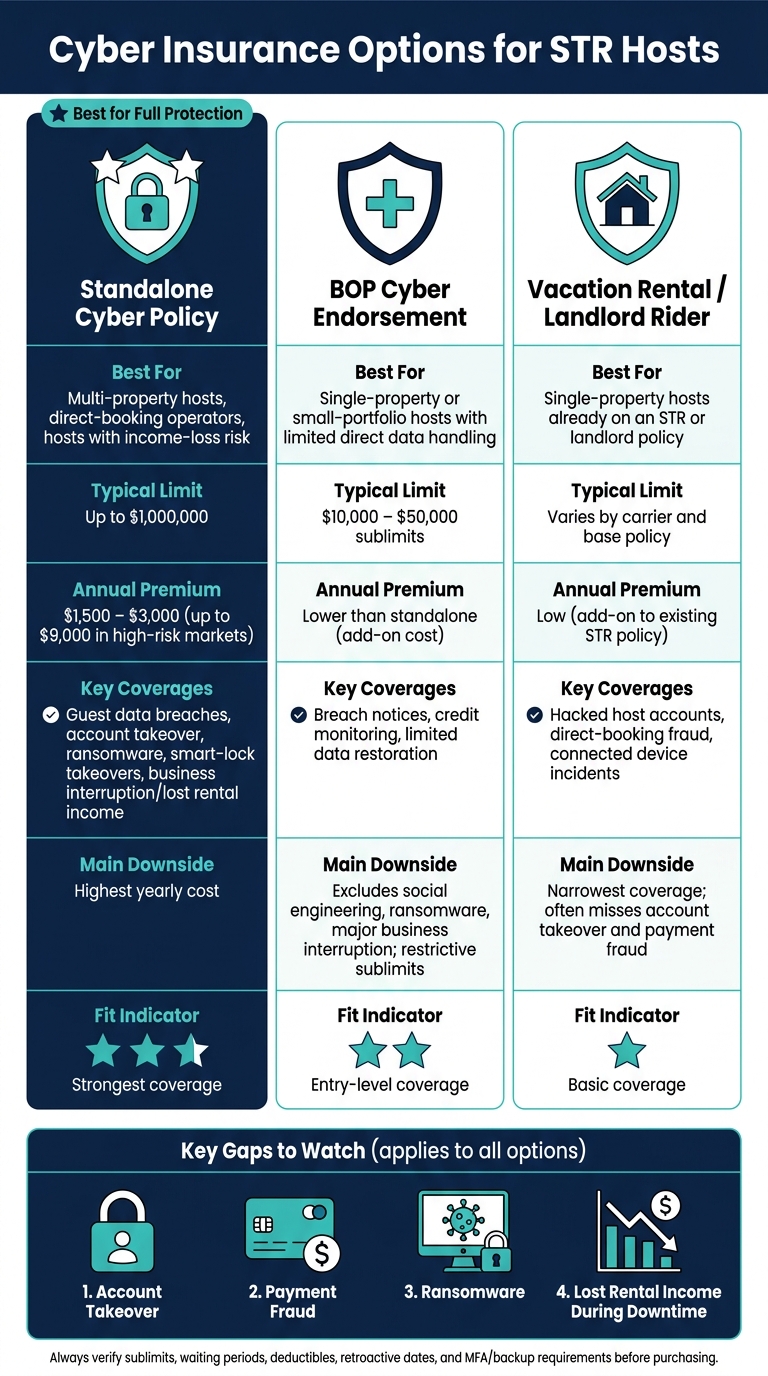
Cyber Insurance Options for Short-Term Rental Hosts: Side-by-Side Comparison
Quick Comparison
| Option | Best for | Typical limit range | Main downside |
|---|---|---|---|
| Standalone cyber policy | Direct-booking hosts, multi-property hosts, hosts with income-loss risk | Up to $1,000,000 in some cases | Highest yearly cost |
| BOP cyber endorsement | Small hosts already carrying a BOP | Often $10,000 to $50,000 sublimits | Lower limits and more exclusions |
| Vacation rental / landlord rider | Hosts already on an STR or landlord policy | Varies by carrier and base policy | Narrower protection than standalone |
So if I were picking based on fit alone, I’d think about it this way: simple setup, lighter coverage; direct bookings, more devices, or more revenue at risk, stronger coverage.
sbb-itb-103bddb
1. Standalone Direct Carrier Cyber Policies
A standalone policy is built for the cyber risks that come with running a short-term rental. It comes with its own terms, its own limits, and its own claims process. For hosts who want cyber protection without leaning on a broader property policy, this is the clearest apples-to-apples option.
Coverage and STR Incident Fit
Standalone policies are made for hosts with active digital operations. They can cover guest data breaches, fraud tied to hacked host accounts, smart-lock takeovers, and lost rental income during downtime [1][3][4].
That matters because many STR hosts rely on OTA accounts and connected devices every day. If one of those accounts gets compromised, bad actors can use it to scam guests [4]. A standalone setup works well for hosts who want cyber coverage with its own limits and a separate claims path.
Limits and Sublimits
Some specialized STR policies may offer limits up to $1 million, though business interruption sublimits can differ by carrier [1]. That part matters more than it may seem at first glance. A policy might show a solid top-line limit, but the amount available for rental income loss could be much lower.
Business interruption coverage can help with lost rental income. Even so, hosts should confirm both the main limit and any sublimits directly with the carrier.
Cost and Eligibility
Premiums usually fall between $1,500 and $3,000 per year, though higher-risk markets can reach $9,000 [1]. Carriers often look at a few core factors:
- Property location
- Property size
- Security controls, such as separating guest devices from the main network
- Guest-screening steps like ID checks and fraud screening [5][7][8]
In plain terms, carriers want to know whether your setup lowers the odds of account abuse, device compromise, or guest fraud.
If your operation already runs on a business owners policy, the next option to compare is a cyber endorsement added on top of that base policy.
2. Business Owners Policy (BOP) Cyber Endorsements
A Business Owners Policy combines general liability and commercial property coverage in one package. Many insurers also let you add a cyber endorsement to that policy. For smaller operations, that can be a lower-cost way to get some cyber protection without paying for a separate policy.
If you already carry a BOP for property and liability, this add-on gives you a limited layer of cyber coverage. Think of it as a small safety net, not a full cyber policy.
Coverage Scope
BOP cyber endorsements often pay for breach notices, credit monitoring, and limited data restoration. But the limits are narrow, and the exclusions matter.
They often leave out:
- Social engineering
- Ransomware
- Major business interruption
So while the endorsement may help with the first wave of cleanup, it may not do much if an attack spreads into lost income or fraud.
Limits and Sublimits
Cyber sublimits are often low, usually in the $10,000 to $50,000 range. That money can disappear fast once notification costs, forensic work, and downtime start piling up.
A host might think, “$25,000 sounds like enough.” Then a breach hits, and that amount gets eaten up by a few line items. That’s the catch with sublimits: they look fine on paper until the bills start coming in.
STR Incident Fit
These endorsements tend to fit hosts who rely on Airbnb or VRBO, where the platform handles most payment processing and the host has less direct exposure to guest data [1][6]. They can also make sense for hosts who use smart locks, noise monitors, and smart thermostats [7][9].
If the endorsement says it covers connected devices, check the wording closely. It should spell out coverage for connected access control or other IoT-related incidents [7]. That detail matters. “Device coverage” can sound broad, but the policy language may be much tighter than it first appears.
The fit comes down to how much digital exposure the host actually has. A host with platform-only bookings has one risk profile. A host running several connected systems and storing more guest data has another.
Cost and Eligibility
Adding a cyber endorsement to a BOP is usually cheaper than buying a standalone policy, which makes it a practical starting point for single-property hosts or small portfolios. At the same time, homeowners policies usually do not cover STR business claims [3][2].
That gap becomes more of a problem for hosts with direct bookings or heavier device use. They tend to have more holes in coverage, which is why the next option matters. Hosts that need broader protection should compare vacation rental or landlord policy riders next.
3. Vacation Rental or Landlord Policy Cyber Riders
If you already have a rental or landlord policy, a cyber rider can give you some added protection without making you buy a separate standalone policy.
Coverage Scope
These riders usually cover things like hacked host accounts, direct-booking fraud, and incidents tied to connected devices [4][3]. They’re built for rental policies, not standard homeowners insurance. That puts them in the middle: more tailored than a BOP add-on, but not as complete as a standalone cyber policy.
Limits and Sublimits
Pricing usually depends on the base rental policy and how much cyber coverage you add.
STR Incident Fit
This setup makes the most sense for hosts who want cyber coverage folded into an existing STR or landlord policy instead of managing a separate cyber contract. It can be a good match for hosts who handle direct bookings and run properties with a smart-home setup. Smart locks, sensors, and thermostats can create weak spots, and those issues may call for specialized coverage or technical isolation [3][5].
Cost and Eligibility
To qualify, you usually need to be on a commercial or vacation rental policy, not a standard residential form [3]. Some STR insurers include riders in their main product lineup. AirCover is supplemental, not primary cyber coverage [3][4].
How well this option fits comes down to two things: how much guest data you handle and how much cyber risk you want built into the main rental policy.
Pros and Cons by Host Type
Not every host needs the same level of cyber coverage. The right fit comes down to three things: how much guest data you handle yourself, how many properties you manage, and how much income you’d lose if a cyber incident shut things down.
| Insurance Option | Best-Fit Host Type | Pros | Cons / Watch-Outs |
|---|---|---|---|
| Standalone Cyber Policy | Multi-property hosts or direct-booking operators with high downtime exposure | Highest limits; separate coverage; broader business interruption protection | Most expensive; may be more than a single-unit host needs |
| BOP Cyber Endorsement | Single-property or small-portfolio hosts with limited direct data handling | Bundles with general business liability; reasonable starting point | Restrictive sublimits; narrow definitions of what counts as a cyber event |
| Vacation Rental / Landlord Rider | Single-property hosts already on an STR or landlord policy | Low cost; simple add-on to an existing STR policy | Narrowest coverage; often misses account takeover and payment fraud |
The notes below show where each option tends to fit best – and where it can fall short.
Single-Property Hosts With Limited Direct Data Handling
If most of your bookings run through a platform, the big issue is how much guest data you still touch directly. When the platform handles most payment data, your direct exposure is lower. In that case, basic first-party cleanup can matter more than broad liability coverage [4][6].
For many single-property hosts, a vacation rental rider is a solid first move, especially if your STR insurance already offers one for basic response costs [3].
That said, there are two gaps you should watch closely:
- Account takeover
- Payment fraud
A basic rider may leave out both. If you also take direct bookings or keep more guest data on hand, standalone coverage starts to make more sense.
Multi-Property Hosts Using PMS, Channel Managers, and Smart Devices
Once you’re running even one listing through several connected tools, cyber risk stops being just a data issue. It becomes an operations issue too. PMS platforms, channel managers, smart locks, and sensors all add more points where something can go wrong. Put simply, the more connected your setup is, the more ways an attacker can get in.
And if one account gets hit, the damage may not stay in one place. A single compromised login can disrupt bookings across several listings [4]. That’s why hosts with multiple properties and connected systems often lean toward standalone coverage.
A BOP endorsement is often too limited for this kind of setup. Low sublimits and narrow event definitions can leave out common incidents [3].
Small STR Businesses With Revenue Interruption Risk
If downtime can stop bookings across several units, business interruption coverage becomes the main thing to look at. This is where the math gets blunt: when annual revenue is high, even a short outage can lead to a serious loss.
So the issue isn’t just whether a policy includes cyber coverage. The issue is whether the limit would hold up during an actual outage.
BOP endorsements and vacation rental riders usually offer tighter coverage. Standalone policies are more likely to include separate limits and broader incident response for hosts facing real income disruption. If your STR business runs more like a small company than a side gig, or if you use vacation rental property management services to scale,, that difference can hit your bottom line fast.
Conclusion
In practice, the choice depends on two things: how much guest data you store and how many systems your rental relies on.
If you run a simple, single-property setup, a BOP endorsement or vacation rental rider may be enough. But if you manage multiple properties and depend on a PMS, channel manager, direct booking site, or smart devices, standalone cyber coverage makes more sense, especially if downtime would cut into revenue.
Before you buy, check the fine print. Look at:
- what triggers coverage
- sublimits
- the deductible or retention
- the waiting period
- the retroactive date
You should also confirm whether the policy requires certain security steps, like multi-factor authentication (MFA) and regular backups.
Most of all, compare the policy to your biggest likely loss. Pick the coverage that fits your actual risk, not just the lowest premium.
FAQs
Do I need cyber insurance if I only use Airbnb or Vrbo?
Yes. Even if you only list on Airbnb or Vrbo, you may still need your own third-party short-term rental cyber coverage.
A standard homeowners policy usually doesn’t cover every cyber-related issue. And platform programs like AirCover don’t cover every gap either.
If you run STR tech like Wi-Fi, smart locks, or guest-facing devices, a cyber policy can help cover the risks those tools bring with them.
What cyber risks are most likely for STR hosts?
STR hosts face the most risk when smart devices and guest equipment sit on the same flat, unsecured network. In that setup, a malicious guest may use weak points to reach smart locks, shut off security systems, or get into private owner accounts.
Poor network segmentation can also let malware move from one device to another. And that can snowball fast: privacy violations under laws like CCPA or GDPR, plus insurance claims that may be denied.
How much cyber coverage should a host carry?
It depends on your property’s risk profile. Standard policies often leave out business-related digital liabilities, so cyber protection isn’t always part of the package.
Many specialized vacation rental policies include up to $1,000,000 in general liability and property damage coverage. But cyber protection is a separate issue. What you need will come down to how your network is set up and how you handle guest data.
For high-value homes or larger portfolios, weak safeguards can even lead to denied claims.