

If you own a vacation rental in 2026, the big point is simple: 100% bonus depreciation is back for qualifying property acquired after January 19, 2025. That means many short-life assets – like furniture, appliances, and some outdoor improvements – may be written off in the first year instead of over 5, 7, or 15 years.
Here’s what I’d want to know right away:
- The building does not qualify. A vacation rental building is usually 27.5-year property, so bonus depreciation does not apply to that part.
- Land does not qualify either.
- Items with a recovery period of 20 years or less may qualify, including furniture, electronics, carpeting, smart locks, driveways, fences, and landscaping.
- Timing matters. The acquisition date rule changed under the new law, and a contract signed on or before January 19, 2025 can change the result.
- Use matters too. Personal-use days, average guest stay, and material participation can decide whether a loss is allowed or limited.
- Cost segregation can change the math. It may move part of the purchase price into 5-, 7-, or 15-year property, which can lead to a much larger first-year deduction.
- Records matter. You need proof of basis, placed-in-service date, rental days, personal-use days, and time spent on the activity.
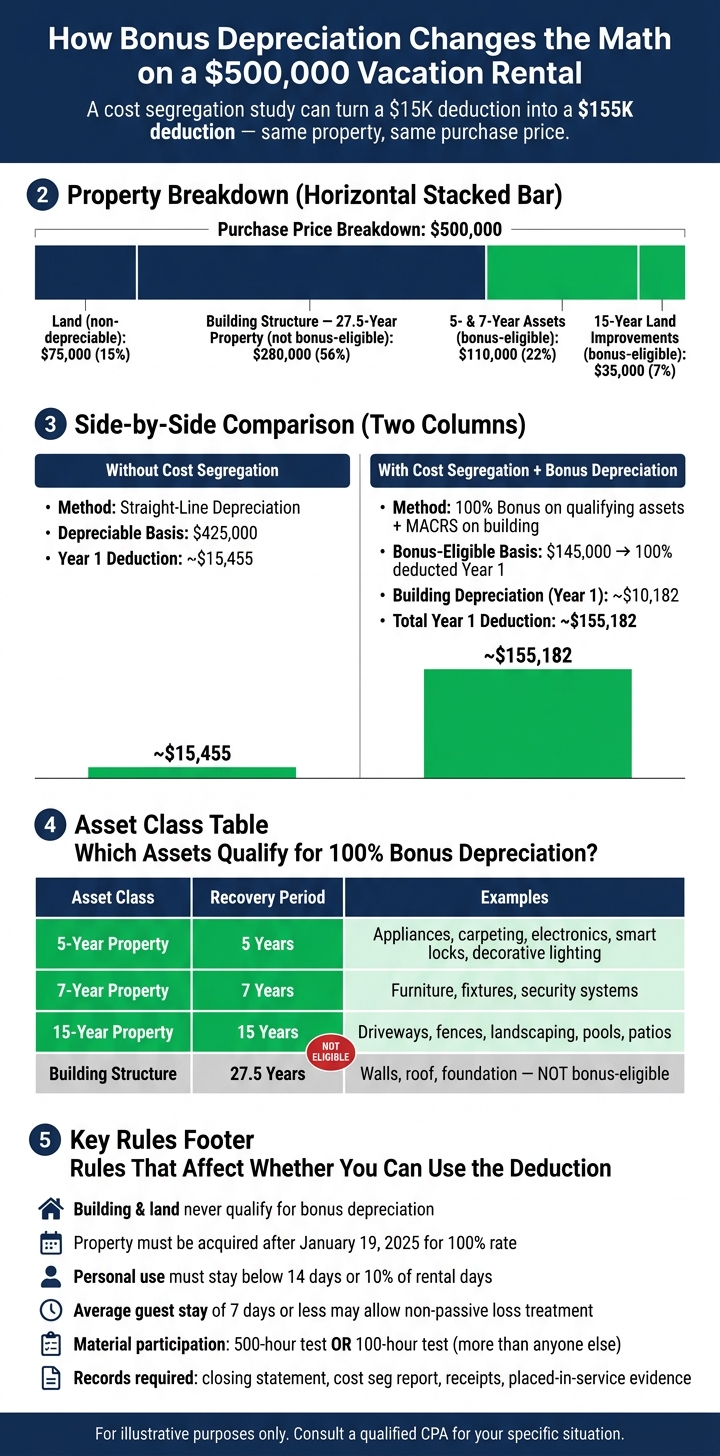
A simple example shows why owners care: on a $500,000 rental with $75,000 allocated to land, a cost seg study might push $145,000 into bonus-eligible classes. That can turn a modest first-year depreciation deduction into one that is more than $150,000.
The Short-Term Rental ‘Loophole’ & Bonus Depreciation – What Actually Works
sbb-itb-103bddb
Quick Comparison
| Method | First-year write-off | Building eligible? | Can create a tax loss? |
|---|---|---|---|
| Regular depreciation | Spread over years | Yes | Yes |
| Bonus depreciation | 100% for qualifying assets | No | Yes |
| Section 179 | Immediate, subject to limits | Usually no | No |
If you want the short version, here it is: know which assets qualify, watch your personal use, track your hours, and keep clean records before you file.
How Bonus Depreciation Works for Vacation Rentals in 2026
Bonus depreciation lets you write off the full cost of qualifying property in the year you place it in service, instead of spreading that deduction over several years.
For short-term rentals, this often applies to items like furnishings, appliances, and land improvements, not the building itself. That part trips people up all the time. Only MACRS property with a recovery period of 20 years or less qualifies. The building is 27.5-year residential property, so it does not qualify. Land never qualifies.
Common examples include furniture, appliances, electronics, smart locks, and land improvements. But there’s a catch: the asset type by itself doesn’t decide the outcome. Owner use and rental activity also affect whether the deduction is allowed.
Which Vacation Rental Assets Qualify for the First-Year Write-Off
Qualifying assets usually fall into three main buckets based on recovery period:
| Asset Category | Recovery Period | Common Vacation Rental Examples |
|---|---|---|
| 5-Year Property | 5 years | Appliances, carpeting, electronics, smart locks, decorative lighting |
| 7-Year Property | 7 years | Furniture, certain fixtures |
| 15-Year Property | 15 years | Fencing, driveways, patios, outdoor lighting, landscaping |
| Building Structure | 27.5 years | Walls, roof, foundation – not bonus-eligible |
For a newly furnished vacation rental, those costs can pile up fast. Professional vacation rental management can help track these expenses and maximize your ROI. And if you use a cost segregation study, part of the building may be moved into shorter-life categories, which can expand the first-year deduction.
Placed-in-Service Dates and the Restored 100% Rule
The placed-in-service date is the date an asset is ready and available for rent, not always the date the first guest checks in [7]. That difference matters more than it may seem. It decides which bonus depreciation rate applies, and using the wrong acquisition date can shrink the deduction or wipe it out.
The OBBBA permanently restored 100% bonus depreciation for qualifying property acquired after January 19, 2025, with no scheduled phase-down [6]. Property acquired on or before that date generally follows the earlier phase-down rate, even if it is placed in service later [4][6].
There’s one more timing rule that matters. A written binding contract signed on or before January 19, 2025, counts as the acquisition date [4]. So if you’re trying to line up the deduction, contract timing isn’t a small detail. It can change the result.
Bonus Depreciation vs. Regular Depreciation vs. Section 179
These three methods differ in how fast you deduct costs, what limits apply, and whether they can push you into a tax loss:
| Feature | Regular MACRS | Bonus Depreciation | Section 179 |
|---|---|---|---|
| 2026 Rate | Annual MACRS slice | 100% in Year 1 | Immediate up to annual cap |
| Building Eligible? | Yes (27.5 or 39 years) | No | Generally no |
| Dollar Limit | None | None for most STR assets | Subject to annual investment limits |
| Can Create a Loss? | Yes | Yes | No |
The next section shows how rental use, personal use, and material participation affect whether you can claim it.
Who Qualifies: Rental Use, Personal Use, and Short-Term Rental Tests
Bonus depreciation can look like a big tax win on paper. But it only works if the rental-use rules let the loss through.
The IRS looks at three things:
- How you use the property
- How long guests stay
- Whether you materially participate
Miss one of those tests, and the deduction can be reduced or blocked.
Personal-Use Limits That Can Restrict Your Deductions
The IRS uses the greater-of-14-days-or-10%-of-rental-days test. If your personal use goes over that limit, the property is treated as a residence, and losses are limited to rental income[1][8].
Personal use includes stays by you, family members, or anyone paying below market rate[1]. Days spent on repairs or maintenance do not count, so it helps to track repair days separately from personal stays[4][3].
If you pass the personal-use test, that doesn’t settle everything. Guest-stay length and participation still decide whether the loss is passive.
Average Guest Stay Length and Material Participation Rules
For short-term rentals, average stay length helps decide whether bonus depreciation losses are passive or nonpassive. Per IRS Publication 925, if the average guest stay is 7 days or less, the loss may fall outside the passive activity rules[2]. That opens the door for losses created by bonus depreciation to offset active income, such as W-2 wages, but only if you also meet a material participation test[2][3][4].
You also need to materially participate, usually by meeting the 500-hour test or the 100-hour test and putting in more hours than anyone else involved[3][4]. If you hire a property manager and their team logs more time on the property than you do, you may fail the 100-hour test. If that happens, you can lose the ability to use those losses against other income[7][4].
Even then, mixed personal use can still limit or prorate the deduction.
How Mixed Personal and Rental Use Changes Your Tax Result
Even if your personal use stays below the 14-day threshold, you still have to prorate expenses. The IRS requires you to allocate costs like utilities, insurance, and depreciation based on the ratio of rental days to total days used[3][8]. So even a small amount of personal use trims the deduction. Cross the threshold, and the property’s tax treatment changes altogether.
The table below shows how different use patterns affect bonus depreciation treatment:
| Scenario | Personal Use | Deduction Outcome |
|---|---|---|
| Rental property | Below 14 days and below 10% of rental days | Deductions are prorated based on rental-use days; losses may be usable if the activity qualifies as non-passive |
| Residence (vacation home) | Exceeds greater of 14 days or 10% of rental days | Deductions are limited to rental income; no deductible loss |
| 14-day rental rule | Rented 14 days or fewer during the year | Rental income is generally not taxable, but no expenses or depreciation are deductible |
Day counts drive the result. They decide whether losses are limited, prorated, or available to offset other income. After that, the next step is figuring out the first-year write-off and making sure the paperwork backs it up.
How First-Year Write-Offs Are Calculated and Documented
Bonus Depreciation vs. Regular Depreciation vs. Section 179 for Vacation Rentals (2026)
Once you meet the use tests, the next job is simple in theory but picky in practice: figure out your basis and keep records that back up every number.
Using Cost Segregation to Find Bonus-Eligible Assets
A cost segregation study is a detailed look at the property that splits the purchase price into asset classes. Instead of putting the whole building on a 27.5-year schedule, the study pulls out parts of the property with shorter recovery periods. Those shorter-life items may qualify for 100% bonus depreciation in Year 1 [2][6].
Here’s how those assets are usually grouped after a study [2][6]:
| Asset Class | Recovery Period | Common Examples |
|---|---|---|
| 5-Year Property | 5 Years | Appliances, carpeting, cabinetry, electronics, decorative lighting |
| 7-Year Property | 7 Years | Furniture, fixtures, security systems |
| 15-Year Property | 15 Years | Driveways, fences, landscaping, pools, sidewalks |
In many cases, a study reclassifies 20% to 35% of basis into 5-, 7-, and 15-year property [5][6]. That’s the part that can change the math fast.
For smaller properties in the $200,000–$500,000 range, a remote study may do the job. Bigger properties often call for an engineer-reviewed study [6].
One thing you can’t skip: land is never depreciable. You need to carve land value out of the purchase price before you calculate depreciable basis. Owners usually do that with the property tax assessor’s ratio or a qualified appraisal [2][7].
A First-Year Deduction Example for a New Vacation Rental
Once the bonus-eligible basis is mapped out, the first-year write-off is pretty straightforward.
Say you buy a short-term rental for $500,000 in early 2026 and place it in service by March 1. If $75,000 of that purchase price is land, your depreciable basis drops to $425,000.
Then a cost segregation study finds:
- $110,000 in 5- and 7-year assets
- $35,000 in 15-year land improvements
Both groups may qualify for 100% bonus depreciation under current law. That leaves $280,000 for the building itself, which depreciates over 27.5 years. In Year 1, that comes out to about $10,182.
So your first-year deduction is roughly $155,182, compared with $15,455 under straight-line depreciation.
That’s a huge gap. Same property, same purchase, very different tax result.
Records You Need Before You File
This deduction lives or dies on paperwork. If records are missing, or if they were pieced together later from memory and random statements, the IRS can throw out the claim.
Before you file, have these records ready:
- Closing statement showing purchase price and land allocation
- Cost segregation study report with a detailed asset-by-asset breakdown
- Receipts for all furnishings and appliances
- Renovation invoices broken down by component, not just one lump-sum contractor bill
- Placed-in-service evidence showing the property was available and ready for rent, like the date the listing went live, photos of the finished space, and calendar availability screenshots [7]
- Guest-stay reports from Airbnb or VRBO showing booking dates and stay lengths
- Owner-stay log that tracks personal-use nights apart from guest stays [1][3]
- Dedicated business bank and credit card statements showing rental income and expenses without mixed personal charges [1][3]
Those records help prove rental use, basis, and placed-in-service timing if the IRS takes a closer look. Keep digital copies for at least seven years. Rank One Stays can help owners keep booking records, guest-stay reports, and owner-use logs in order if they want a more hands-off setup.
Next, the filing mistakes below are the ones that most often wipe out these tax savings.
Common Filing Mistakes and When Professional Support Helps
Filing Errors That Cost Owners the Most
Once you know the rules, the next problem is filing them the right way.
A lot of the costliest mistakes aren’t fancy tax issues. They’re small misses that happen before anyone even touches a return.
Treating the entire building as bonus-eligible. Only cost-segregated 5-, 7-, and 15-year assets qualify [2][6].
Ignoring personal-use days. If you go over the personal-use limit, the property can be treated as a residence, which limits losses [1][3].
Missing the 7-day average stay rule. Average stays over 7 days can cause the activity to be treated as a passive rental activity [5][3][4].
Using the wrong placed-in-service date. The deduction starts when the property is ready to rent, not when the first guest checks in [7].
Reporting net payouts instead of gross bookings. Airbnb and VRBO send payouts after service fees, but the IRS wants total gross revenue reported. If you underreport by more than 25%, the audit window can stretch from three years to six years [1][3].
DIY Recordkeeping vs. Professional Vacation Rental Management
Most filing mistakes come from poor records, not hard tax rules.
That makes sense. Many short-term rental hosts also have full-time jobs, so staying on top of detailed, same-time documentation can slip fast [9].
Here are the main weak spots:
| Area | DIY Recordkeeping | Professional Management |
|---|---|---|
| Booking and Stay-Length Records | Manual spreadsheet entry; gaps in booking dates and stay-length data are common | Automated via PMS with average length-of-stay reporting |
| Maintenance Invoices and Receipts | Owner collects, categorizes, and reconciles every receipt and statement | Manager provides monthly itemized statements, digital copies, and consolidated P&L |
| Owner-Use Records | Personal calendar; hard to defend in an audit | Calendar-blocked dates with clear owner-use designations |
| Audit Defensibility | Depends entirely on owner discipline | Provides a cleaner paper trail for revenue and activity |
If you use a full-service manager, pay close attention to the 100-hour material participation test. You need to log at least 100 hours and more time than any other person [4][7].
That last part trips people up.
If the manager or cleaner spends more time on the property than you do, you can fail the test even if you hit 100 hours yourself. So if you’re counting on non-passive losses, you need to track your own time with care or aim for the 500-hour threshold instead.
Clean records are much easier to defend when someone is handling the paper trail day in and day out. Rank One Stays keeps booking confirmations, invoices, owner-use logs, and monthly reports organized for your CPA.
Conclusion: The Key Rules to Get Right in 2026
Documentation quality decides whether a deduction stands up in an audit.
Each asset claimed for bonus depreciation needs a cost segregation study that backs up the class. Each rental-use day, owner-use day, and participation hour needs a same-time record. Rebuilt logs usually don’t hold up [4].
Work with a qualified CPA who knows short-term rental rules. Add a management company that keeps the operation organized, and the return is in a much better position if the IRS comes asking.
FAQs
Does my vacation rental building qualify for 100% bonus depreciation?
No. The building itself does not qualify for 100% bonus depreciation.
Under IRS MACRS rules, residential rental buildings are depreciated over 27.5 years. That means the structure gets written off slowly, not all at once.
What changes the picture is a cost segregation study. This study can reclassify part of the property – often 20% to 40% – into shorter-life assets such as 5-, 7-, or 15-year property.
That can include things like:
- Furniture
- Appliances
- Certain land improvements
Those reclassified assets may then qualify for bonus depreciation.
How much personal use limits my deduction?
Your deduction is often limited if the property is treated as personal use, or if you don’t meet the rental activity and material participation rules.
For short-term rentals, the 7-day rule matters. If the average customer stay is 7 days or less, the activity may be treated as non-passive if you materially participate.
Personal use changes the math too. You’ll need to prorate expenses, which means only part of your costs may be deductible. That usually leads to a smaller deduction.
Do I need a cost segregation study to claim bonus depreciation?
Not always. You don’t have to hire an engineering firm, but the IRS does expect your method to be accurate and backed by solid records.
A cost segregation study is what moves certain components into 5-, 7-, and 15-year recovery periods, which may make them eligible for bonus depreciation. Without that study, those same items will usually remain on the standard 27.5-year residential schedule. Check your approach with a qualified CPA.