
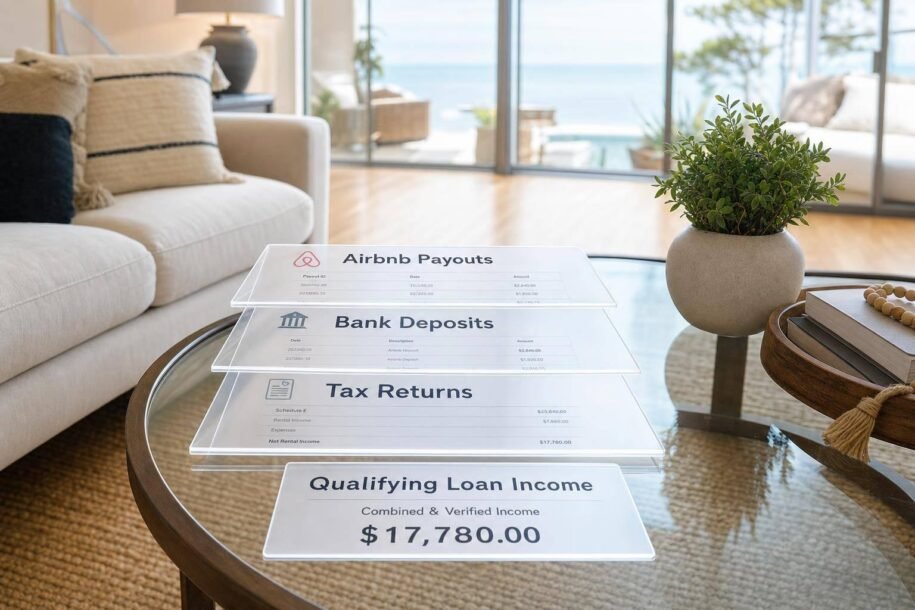
Most lenders won’t use your Airbnb gross revenue. They usually count net income after fees, refunds, cleaning, and other costs.
If I’m applying for a loan with Airbnb income, I should expect the lender to check 12 to 24 months of records, compare payout reports to bank deposits, and review tax returns to see what income is left after expenses. For many files, that means the number I qualify with can be far lower than the top-line booking total. In many short-term rentals, costs can eat up 45% to 65% of gross revenue.
Here’s the short version:
- Gross bookings usually do not count
- Net income is what matters
- Conventional loans often want 12 to 24 months of rental history
- Schedule E or Schedule C can change how income is reviewed
- DSCR and some non-QM loans may use property cash flow, bank deposits, or rent projections
- If there isn’t enough history, lenders may use market rent, not Airbnb nightly income
- Many projected-rent setups use only 75% of rent after a 25% vacancy/cost cut
- DSCR lenders often look for about 1.0x to 1.25x coverage of PITIA
A simple way to think about it: I need to show where the money came from, where it went, and what was left.
| Loan setup | What lenders often focus on | What can limit income used |
|---|---|---|
| Conventional | Tax returns, rental history, market rent | Short history, lower recent income, expense load |
| DSCR | Property cash flow and rent support | Weak ratio, soft rent estimate |
| Bank-statement / non-QM | Recurring deposits and cash flow | Mixed accounts, uneven deposits, short history |
If I want the cleanest file, I’d line up payout reports, matching bank deposits, and tax returns before I apply.
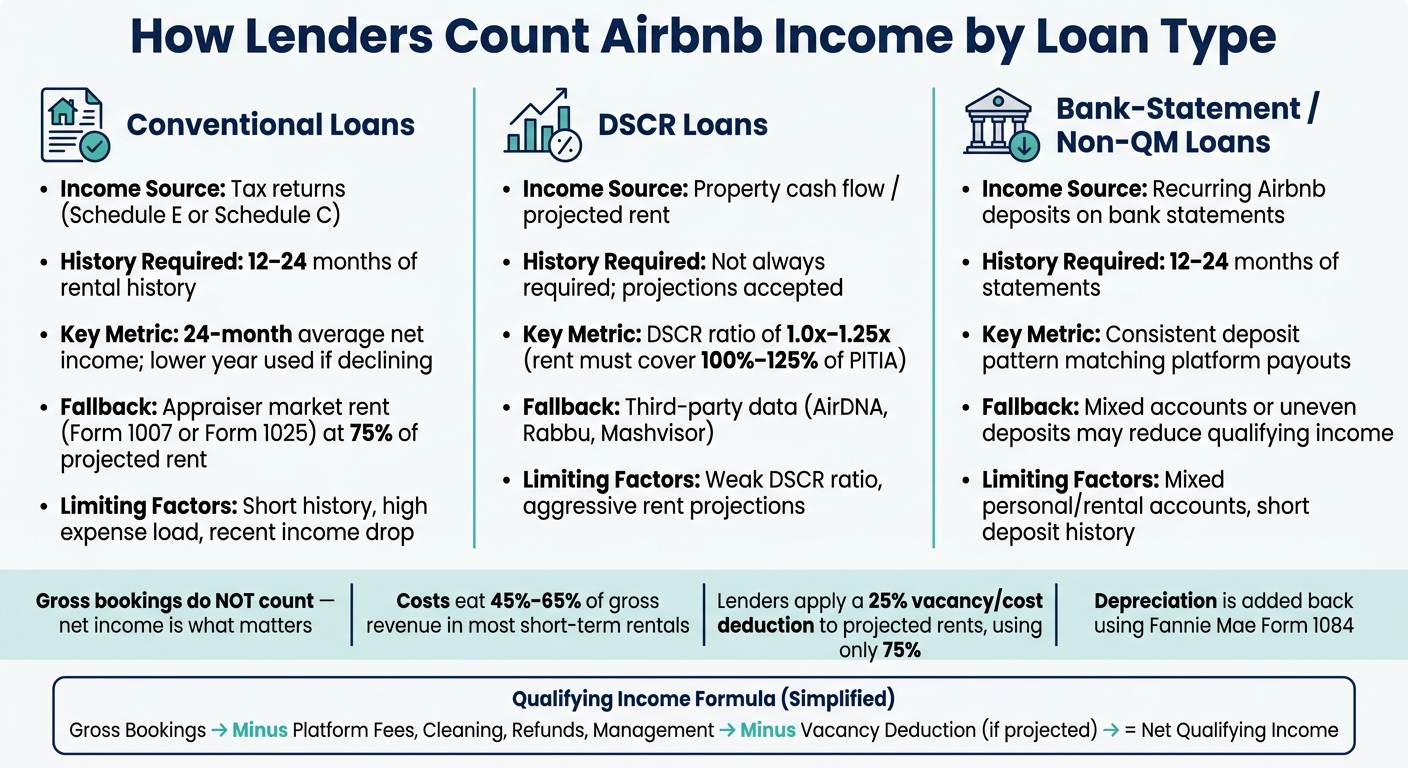
How Lenders Count Airbnb Income: Loan Types Compared
Can You Use a DSCR Loan for an Airbnb?
sbb-itb-103bddb
Step 1: Gather the Income Documents Lenders Will Verify
This step is about building the paper trail lenders use to turn Airbnb bookings into qualifying income. To do that, they look at three main records and use them to separate gross bookings from the income that can count for your loan.
Platform Payout Reports
Start with your monthly earnings report. It shows gross bookings, fees, refunds, and net payouts. That matters because a 1099-K only shows gross transaction volume, not what actually hit your bank account [4][7].
Payout reports also help show how the property is doing right now. That’s useful when older tax returns don’t reflect your current numbers.
Bank Deposits That Match Airbnb Payouts
Lenders will pull your bank statements and check whether each platform payout appears as a deposit for the right amount. This helps them confirm that your net payouts are consistent. If there are gaps or the numbers don’t line up, underwriting can slow down [4][7].
Use a separate bank account for the rental. If you mix personal and rental funds, underwriters may have to review transactions line by line. That’s a headache, and it can even lead to a loan denial [4].
They’ll also review recent statements to make sure the deposits match the payouts. That deposit history then becomes part of the income averaging in Step 2.
Tax Returns, Schedule E, and Schedule C
Your tax filing matters more than many hosts think. If the income is reported on Schedule E for a standard rental with no substantial services, the lender may treat it one way. If it’s on Schedule C because you offer hotel-like services, such as daily cleaning or meals, the lender may treat it another way [4][7].
Schedule E or Schedule C shows net income. Depreciation may be added back if the loan program allows it, using the lender’s income worksheet [6]. After that, lenders compare those adjusted figures with your payout reports and bank deposits.
These are the records that feed the income calculation in Step 2.
Step 2: How Lenders Convert Airbnb Revenue Into Qualifying Income
Once payout reports, bank deposits, and tax returns match up, underwriters turn that paper trail into qualifying income. They verify the documents first. Then they work through three layers: tax-return averaging, payout and deposit math, and expense deductions. That’s how they arrive at the income figure they can use for the loan.
How Tax-Return Income Is Averaged and Adjusted
For conventional loans, tax returns are usually the starting point. Lenders often average 24 months of net income from Schedule E or Schedule C. Some use a three-year trailing average to smooth out swings from year to year. If the most recent year is lower than the year before it, they usually go with the lower, newer figure instead of averaging both years [6].
One of the main adjustments is the depreciation add-back. Depreciation is a non-cash expense, so lenders add it back to net income on Fannie Mae Form 1084 (Cash Flow Analysis) [6].
How Payout Reports, Deposits, and Gross Receipts Are Reduced
When lenders rely on payout reports or bank deposits, they look at net receipts, not gross bookings. In plain English, they care about what you actually received, not the top-line number shown before fees and other reductions.
If a lender has to use projected rent instead of your tax history, they often apply a 25% vacancy and operating-cost deduction. That means they count only 75% of the projected rent [9].
The host fee is already netted out before the payout hits your bank account [7]. Underwriters line up the platform report against your deposits before they lock in the income figure.
How Cleaning Fees, Platform Fees, Refunds, and Management Costs Affect Income
Cleaning fees usually wash out in underwriting. The fee collected is offset by the cleaning expense [4]. So while that money may move through your account, it often doesn’t add much, if anything, to qualifying income.
Platform fees, refunds, chargebacks, and management fees also cut into the amount a lender can use. A booking may look strong at first glance, but once those costs come off the top, the number lenders care about gets smaller.
Those adjusted figures become the starting line for the next call: whether the lender will rely on your actual history or use projected income.
Step 3: When Projected Airbnb Income Counts Instead of Actual History
If your file doesn’t show enough verified history, the lender may stop looking at tax-return income and shift to market rent or projected cash flow.
Conventional Loans: Using Actual History or Market Rent
With conventional loans, lenders usually want 12 to 24 months of documented short-term rental history before they’ll count Airbnb income for qualifying [1][5].
If you don’t have that history, they may fall back to the appraiser’s rent schedule:
- Form 1007 for single-family properties
- Form 1025 for two-to-four-unit properties
Those forms reflect long-term market rents, not nightly Airbnb rates. In plain English, the number is based on appraiser-supported market rent, not what a strong short-term rental might bring in night by night [2][1].
DSCR, Non-QM, and Bank-Statement Loans: Using Projections or Deposits
Investor-focused loan programs play by a different set of rules. DSCR (Debt Service Coverage Ratio) loans are underwritten based on the property’s cash flow, not your personal income or debt-to-income ratio [3][5].
Bank-statement loans can also help here. Instead of relying on tax returns, they may count recurring Airbnb deposits shown across 12 to 24 months of statements. So even if you’re buying a new property and don’t have your own rental history on that home, you may still qualify if the projected income clears the lender’s DSCR test.
Most DSCR lenders want a ratio in the 1.0x to 1.25x range. That means projected monthly rent needs to cover 100% to 125% of the property’s principal, interest, taxes, insurance, and association dues, or PITIA [6][5].
To back up those projections, lenders often ask for third-party data from sources like AirDNA, Rabbu, or Mashvisor [1][5]. On a purchase loan, some lenders may also accept the seller’s past booking records and direct booking records instead of the buyer’s own history [10].
The more grounded the data is, and the less aggressive the forecast looks, the easier it is for an underwriter to get comfortable with it.
What Strengthens Projected Income for a New or Recently Converted Rental
Projected income tends to hold up better when the numbers are specific and a bit cautious. Lenders usually respond better to comp sets built around properties with a similar bedroom count and quality level, rather than broad city averages [3].
Here’s the idea: if AirDNA shows 72% occupancy in your market, building your projection at 60% to 65% occupancy gives the lender some breathing room [8]. That margin can make the file easier to underwrite.
A signed management agreement from Rank One Stays can also help support conservative projections and cleaner underwriting.
Conclusion: What to Do Before Applying With Airbnb Income
Airbnb income can count, but lenders need to see clean proof. Your payout reports, bank deposits, and tax returns should all line up. That matters because short-term rentals often eat up 45% to 65% of gross revenue, which means the income a lender can use may be far lower than the top-line number you see on paper [1]. Conventional loans tend to lean on documented history, while DSCR and some non-QM loans may look at bank deposits or projected cash flow [1][3].
Use this checklist to tighten up your file before you apply.
A Pre-Application Checklist for Owners and Investors
- Pull 12 to 24 months of platform payout reports and make sure each payout matches a deposit in a dedicated business bank account [1][5].
- Reconcile your tax returns with your platform payout reports and bank deposits [7][4].
- Calculate net qualifying income after platform, management, cleaning, and refund costs [1].
- Ask which income source the lender will use: documented history, deposits, or projections [1][3].
- Show 3 to 6 months of liquid reserves to cover vacancies or repairs [1][5].
FAQs
Can I use Airbnb income if I recently started hosting?
Yes, but it depends on the loan type.
With a conventional loan, lenders usually want 12 to 24 months of documented rental history before they’ll count Airbnb income. No paper trail, no credit for that income in many cases.
DSCR loans work a different way. Instead of leaning on your personal income history, lenders may look at the property’s projected rental income. If it’s a new property, they may estimate that income using market data from sources such as AirDNA.
Why doesn’t my gross Airbnb revenue count for a loan?
Lenders usually don’t use your gross Airbnb revenue on its own. They want income they can document and verify – the kind that shows what can actually support the loan, not just total bookings on paper.
That’s why many lenders look at 12–24 months of rental history or accepted income projections. Even then, they may count only net cash flow or just an allowed share of projected income.
There’s also a simple reason gross revenue can be misleading: gross revenue is not the same as your bank deposits. Airbnb may withhold host service fees, collect taxes, and pass through cleaning fees. So if a lender is checking what you earned, they’ll usually ask for approved payout or earnings records instead of looking only at the top-line booking number.
What documents should I prepare before I apply?
Before you apply, pull together 12–24 months of Airbnb income records. That usually means platform payout reports or exports, bank statements that show the deposits landing in your account, and your tax returns.
You should also have backup for the income you plan to show a lender. This can include:
- Cleaning fee details
- Related expense records
- Any required verified revenue data
- Reserves equal to 3–6 months of mortgage payments
- If it applies, records for Airbnb income from your other properties
The goal is simple: make it easy for the lender to match your Airbnb income to clear, documented records.