

If I own a Scottsdale Airbnb, I plan for a big winter and spring push, then a sharp summer drop. In many cases, February and March reach the low- to mid-80% occupancy range, while July can fall to about 33%. That gap can change both booking pace and yearly revenue with professional vacation rental property management.
Here’s the short version:
- Best demand: January through March, with event weeks often doing even better
- Start of slowdown: April and May
- Weakest stretch: June through August, when highs often reach 103°F to 105°F
- Fall pickup: September through December, with a stronger lift around holidays
- Main levers: pricing, minimum stays, and listing setup
A few numbers stand out:
- March monthly revenue has been reported around $7,066
- July ADR has been reported near $221.75
- December ADR has been reported near $264.80
- February through April can produce 37% of annual revenue in some cases
What do I do with that? I keep rates firm in peak months, loosen stay rules in summer, and make the home look ready for the season. In Scottsdale, that often means event-based pricing in late winter and early spring, then pool, shade, and A/C-focused marketing in summer.
| Period | What I expect | What I focus on |
|---|---|---|
| Jan–Mar | High occupancy and top rates | Hold pricing, protect event dates, use longer minimum stays |
| Apr–May | Demand starts to cool | Ease rates and shorten minimum stays |
| Jun–Aug | Lowest demand of the year | Lower rates, allow short stays, target mid-term bookings |
| Sep–Dec | Demand starts coming back | Stay flexible, then push holiday pricing |
If I want better year-round revenue, I don’t keep the same setup every month. I change the pricing, stay rules, and listing angle to match the season.
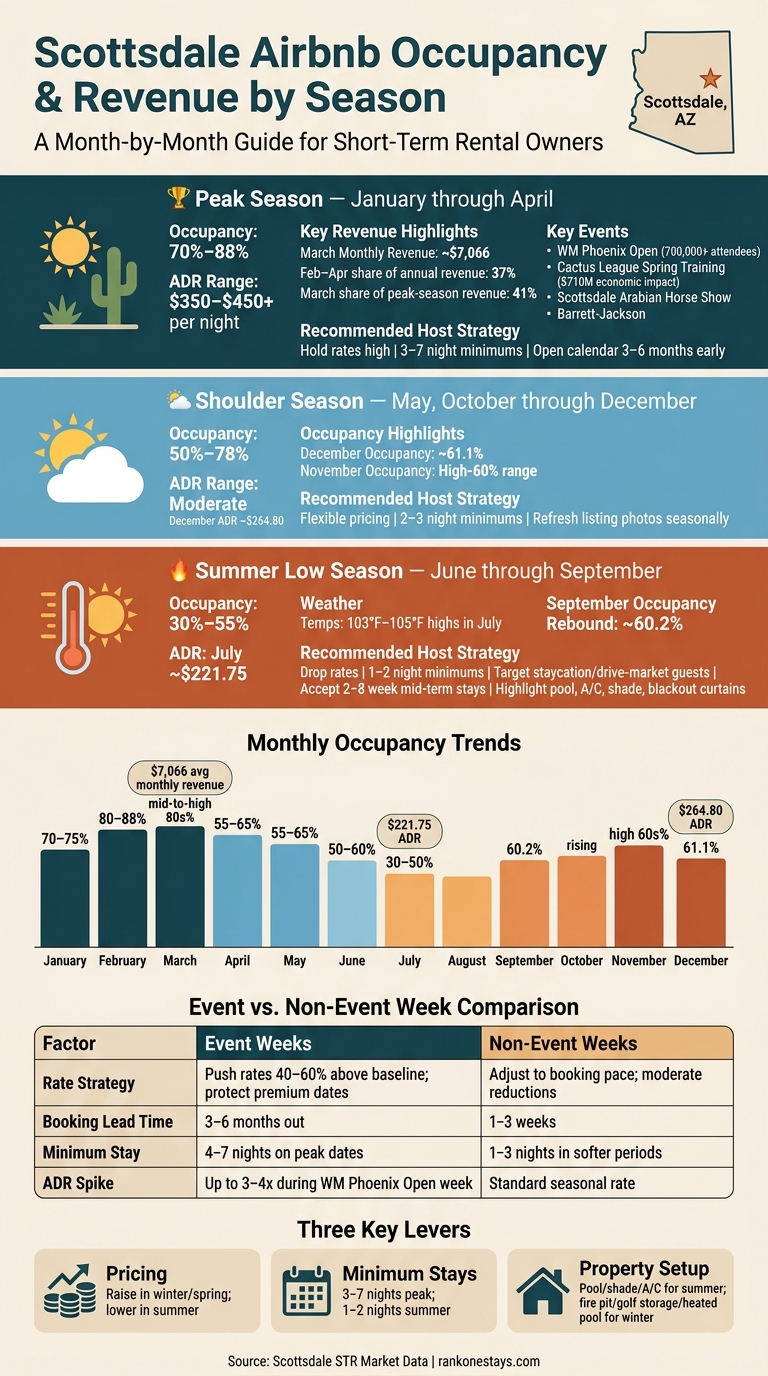
Scottsdale Airbnb Occupancy & Revenue by Season
Scottsdale Airbnb Occupancy by Month
Scottsdale follows a pretty clear pattern: strong winter demand, a summer dip, and a pickup in the fall.
January Through April: Winter Peak and Spring Surge
January starts high season, with occupancy often landing around 70% to 75% for top listings.[8][9] Snowbirds, 67°F weather, and Barrett-Jackson all help drive demand early in the year.[9][18][11] A 3- to 5-night minimum stay usually works well here, with longer minimums around major event dates.
February is usually one of the best months of the year, with occupancy often reaching 80% to 88%.[1][9][12] The WM Phoenix Open, the Scottsdale Arabian Horse Show, and Cactus League Spring Training hit during this stretch, which can create short runs of almost full occupancy.[9][11][3] During event weeks, it often makes sense to require 5- to 7-night minimums or more and open the calendar early for guests who book months in advance.
March often matches February or outperforms it on revenue, with occupancy in the mid- to high-80% range.[1][9][12] Spring Training continues, spring break brings in families, and golf travel stays busy.[2][11][3] Average monthly short-term rental revenue in March has been reported at about $7,066, which is nearly triple what some summer months bring in.[12] This is usually the time to hold firm on peak pricing, keep minimum stays in place, and favor multi-week bookings from repeat guests when you can.
April is still solid, but it also marks the start of the slowdown. Occupancy usually settles into the mid-50% to mid-60% range as snowbirds leave and Spring Training ends.[8][12] The weather is still pleasant, with average highs around 85°F, and leisure travelers still come for golf and outdoor trips.[18] At this point, ease rates down from March and relax minimum stays to 2 to 3 nights to keep nights booked. By May, the focus shifts from top-dollar pricing to defending occupancy.
May Through August: Shoulder Slowdown and Summer Slowdown
May is a transition month. Occupancy tends to fall into the 50% to 60% range as the winter crowd thins and daytime temperatures start to climb.[7][8] Lower ADR from peak-season levels, move minimum stays to 2 to 3 nights, and use 10% to 20% last-minute discounts to fill open dates.
June through August is the weakest stretch of the year. Average occupancy can drop into the 30% to low-50% range for many properties.[9][4][13] July ADR has been reported at about $221.75, well below March levels.[12] Highs above 100°F, often near 105°F in July, cut into leisure demand.[18]
A few tactics matter more in summer:
- Drop minimum stays to 1 to 2 nights
- Put pool photos front and center
- Clearly show cooling features like strong A/C, ceiling fans, blackout shades, and shaded outdoor areas
- Target Phoenix-area staycation guests and drive-market travelers instead of fly-in vacationers
- Accept 2- to 8-week mid-term stays for remote workers or families in the middle of a move[4][13]
When nightly demand gets thin, those mid-term bookings can help steady occupancy.
September Through December: Fall Recovery and Holiday Lift
Fall recovery starts here, though the weather can still feel a lot like summer. September stays hot, but occupancy rebounds to about 60.2% from the July-August low.[14] Keep pricing flexible, stick with short minimum stays, and keep leaning on pool access and cooling features in the listing.
October is when the fall rebound starts to show more clearly. Temperatures ease up, golf season starts picking back up, and leisure travelers return for outdoor trips. Occupancy climbs, and ADR can start moving up from summer lows. It also helps to refresh listing photos so they match the season, like morning patio setups or hiking scenes.
November gets a lift from cooler weather and early holiday travel, including Thanksgiving trips and the first wave of snowbirds, with occupancy often moving into the high-60% range.[1] December gets another bump from Christmas and New Year’s travel, with ADR around $264.80 and occupancy near 61.1%.[15] For key holiday dates, use 3- to 5-night minimums and push ADR harder for Christmas week and New Year’s week.
Those month-to-month swings get even more pronounced during peak weeks and big event periods.
sbb-itb-103bddb
Peak Periods, Shoulder Dips, and Event Weeks
The biggest revenue swings usually come from peak weeks and event dates, not monthly averages.
Peak Travel Windows: Snowbird Season, Spring Training, and February to April Demand
Occupancy can run 82%–92% during the winter-to-spring stretch[5], and rates are often 40%–60% above baseline from January through March[19]. February and March tend to lead the year for both occupancy and ADR because Spring Training and February event traffic pile onto already-strong snowbird demand[7][20].
What makes this stretch so important is how people book it. Peak and event weeks often start filling 3–6 months ahead[6][22]. That gives owners a clear playbook: open calendars early, bump rates as soon as event dates are set, and avoid giving away prime weekends to short bookings that only plug small gaps.
One Scottsdale analysis found that February through April produced 37% of total annual revenue, and March alone made up 41% of peak-season revenue[20]. That’s a huge share packed into a short window, which is why calendar control here can make such a big difference.
Shoulder Season Dips in Late Spring and Early Fall
Late April, May, September, and early October are the main shoulder dips. Later fall is often steadier, with occupancy bouncing back to 65%–78%[5].
Lead times also get much shorter in these periods, often landing around 1–3 weeks[21][22]. In plain English: if booking pace starts to slip, owners can’t wait around. They need to watch pickup week by week and make changes before dates sit too long.
A few moves can help when demand softens:
- Shorten minimum stays
- Refresh listing photos
- Run targeted offers for longer stays
Those small changes can help smooth out occupancy when the market cools off.
Event-Driven Demand Spikes That Can Outperform Normal Seasonal Patterns
Some Scottsdale events blow past normal seasonal patterns. The WM Phoenix Open draws over 700,000 attendees and can push nearby ADR up 3–4x during event week[23][24]. Cactus League Spring Training is another major demand driver, with an estimated $710 million in statewide economic impact in 2023[26][27].
Because of that, event weeks shouldn’t be handled the same way as regular weeks. Rates, lead times, and minimum stays all need a different approach.
| Factor | Event Weeks | Non-Event Weeks |
|---|---|---|
| Rate strategy | Push rates up early and protect premium dates | Adjust to booking pace; use moderate reductions as needed |
| Booking lead time | Open calendars 3–6 months out when events are announced | Expect shorter 1–3 week lead times in softer periods |
| Minimum-stay approach | Two- to four-night minimums for most major event weeks; longer stays can make sense for larger homes around Barrett-Jackson | Relax minimums to improve occupancy, especially in shoulder months |
For Barrett-Jackson, longer minimums can work well for larger homes, while monthly stays still line up with snowbird demand[3][25][6]. Those swings in demand should shape pricing, minimum stays, and how the property is presented.
How to Adjust Pricing, Minimum Stays, and Design by Season
Scottsdale’s seasonality gives you three big levers to work with: pricing, minimum stay rules, and property setup. If you change those levers with the market instead of keeping everything static, you put the home in a much better spot to book well through the year.
Pricing Approach for Peak Season, Shoulder Season, and Summer Low Season
| Season | Pricing Posture | Occupancy Goal | Booking Speed | Discount Strategy |
|---|---|---|---|---|
| Peak (Jan–Apr) | Hold rates high; raise them on event and sold-out nights | 80–90%+[1][5] | Book early | Minimal; protect weekends |
| Shoulder (May, Oct–Dec) | Keep rates flexible; adjust to pickup | 65–78%[24][5] | Weekends book earlier; weekday bookings are shorter | Targeted mid-week and last-minute discounts; hold weekend rates |
| Summer Low (Jun–Sep) | Lower rates; favor longer stays | 35–55% depending on pool[10][5] | Slower, more last-minute | Weekly or monthly rate incentives, flexible minimums |
In peak season, ADR can hit $350–$450+ per night, while summer may land closer to $175–$225.[19][5] That gap is the whole point: if your rates stay flat all year, you leave money on the table in winter and spring, then make summer harder to book than it needs to be.
Minimum-Stay Rules That Match Booking Behavior
After pricing is in place, minimum stays help you guard high-demand dates and smooth out weaker parts of the calendar.
From January through April, a 3–4 night minimum works as a solid baseline for many properties. It cuts down on turnover, helps screen out one-night party demand, and keeps more of your calendar tied to higher-value reservations.[16][30] On major event weekends, it often makes sense to move to a 4-night minimum across the main event dates, then ease back to 2–3 nights on the nearby weekdays. That approach helps you catch the full trip window without creating awkward gaps before or after the event.
In shoulder season, 2–3 night minimums usually give you enough room to fill mid-week openings without having to trim weekend pricing. Summer is where being flexible can pay off fast. 1–2 night mid-week minimums can pull in local staycations and last-minute demand, while weekly or monthly discounts can appeal to remote workers and families in transition who need stays of 2 to 8 weeks.[24][19]
Design and Amenity Updates That Support Year-Round Performance
At some point, pricing and stay rules can only do so much. Then the booking decision comes down to the home itself. In Scottsdale, the best-performing setup often changes by season.
For summer, when daytime highs often hit 105°F or more,[28] a few features matter a lot. Homes with covered patios, pergolas, or mature shade trees that make the yard usable in the middle of the day tend to do better in July and August than homes with little or no shade.[10] Strong A/C matters too. So do blackout curtains in bedrooms and indoor options like streaming TVs or game rooms. Those details help guests stay comfortable during the hottest part of the day, and they tend to show up in reviews.[28][2]
For winter and spring, the draw looks a little different. Golf-adjacent homes with club storage, outdoor dining areas, gas fire pits, and heated pools tend to photograph well and line up with the snowbird and event-traveler demand that drives Scottsdale’s busiest stretch.[2][10] Premium mattresses, better kitchens, and fast Wi-Fi also support longer stays and justify higher peak-season rates.[5][29]
Owners who want to get the property setup right from the start can explore vacation rental interior design and staging services. For owners who want this handled end to end, Rank One Stays provides Scottsdale vacation rental management, dynamic pricing, listing optimization, guest support, housekeeping, and interior design.
Conclusion: Use Scottsdale’s Seasonal Patterns to Grow Airbnb Revenue
Scottsdale rewards owners who work with the calendar instead of against it. Peak-season revenue can be more than double summer revenue, so flat pricing leaves money on the table.[17][33]
Key Takeaways for Investors and Self-Managing Owners
Scottsdale’s revenue pattern comes down to three levers: pricing, minimum stays, and presentation.
Push rates hardest from January through April, with extra attention on March.[7][12] Fall and the holiday period bring a smaller bounce. Major event weeks, like the WM Phoenix Open, Cactus League Spring Training, and the Scottsdale Arabian Horse Show, should be treated as short demand spikes with their own pricing and stay-rule changes.[31][32][34]
The playbook is pretty simple:
- Raise rates in winter and spring
- Loosen minimum stays in summer
- Upgrade amenities around heat relief and pool use
For owners who want local help with those seasonal moves, Rank One Stays handles dynamic pricing, listing optimization, 24/7 guest support, housekeeping, and vacation rental design in Scottsdale. That gives owners a way to match seasonal demand without managing every detail themselves.
FAQs
How far ahead should I open my calendar for Scottsdale event weeks?
For major event weeks in Scottsdale, open your calendar 9 to 12 months in advance to lock in early bookings.
This matters even more during peak snowbird season, from November to April, when event-driven demand can jump fast. By opening your calendar early, you can secure those high-demand dates sooner and give yourself more time to line up pricing and availability with peak travel patterns.
Are mid-term summer bookings better than short stays?
Often, yes. In Scottsdale’s slower summer season, mid-term bookings can beat short stays. A monthly discount of 20% to 30% can still lead to more profit than a short-term-only pricing model.
Why? Because higher occupancy and fewer turnovers can make up for the lower nightly rate. You’re not just filling dates. You’re also cutting cleaning, restocking, and guest-change costs.
Rank One Stays helps owners use dynamic pricing and length-of-stay tactics to stay profitable during off-peak periods by improving occupancy and reducing turnover costs.
Which amenities matter most for summer bookings in Scottsdale?
During Scottsdale’s slower summer months, guests tend to zero in on one thing: staying cool.
That puts swimming pools, dependable air conditioning, and shaded outdoor areas near the top of their wish list. If your property has them, make them hard to miss.
Use listing photos that show off these features clearly, and mention them in your description in plain language. A pool shot, a note about strong A/C, or photos of a covered patio can help your place feel like a better fit for summer travelers and stand out when demand dips.