
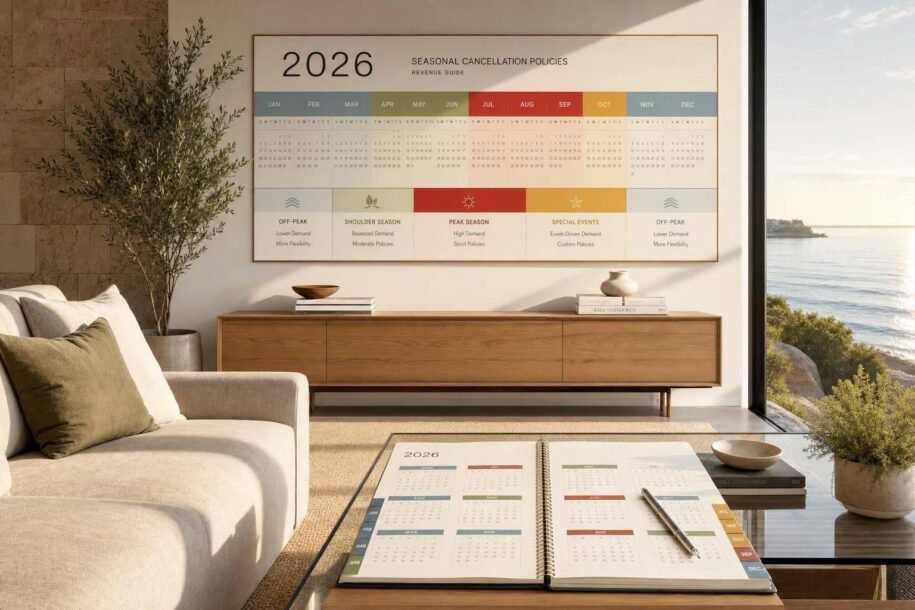
Your cancellation policy should change with demand. If you use the same rules all year, you can lose money in peak months and lose bookings in slow months.
Here’s the short version:
- Peak season: use Firm or Non-refundable terms to protect high-rate dates
- Shoulder season: use Moderate terms to balance bookings and cancellation risk
- Low season: use Flexible terms to help fill open nights
- Holidays and event dates: use a stricter override early, often 90–120 days before arrival
- Match policy changes with minimum stays and pricing, not policy alone
I’d boil the article down to one rule: the harder it is to rebook a canceled stay at the same rate, the more careful you need to be with your cancellation settings.
A few numbers make the point clear:
- Peak-season occupancy in some markets can hit 76%–82%
- South Florida winter occupancy can get close to 90%
- Event demand can push bookings per property up by 29%+
- A place at 65% occupancy and $190/night can beat one at 90% occupancy and $120/night on revenue per available night
That means I would not look at occupancy by itself. I’d look at rate, rebooking odds, and timing.
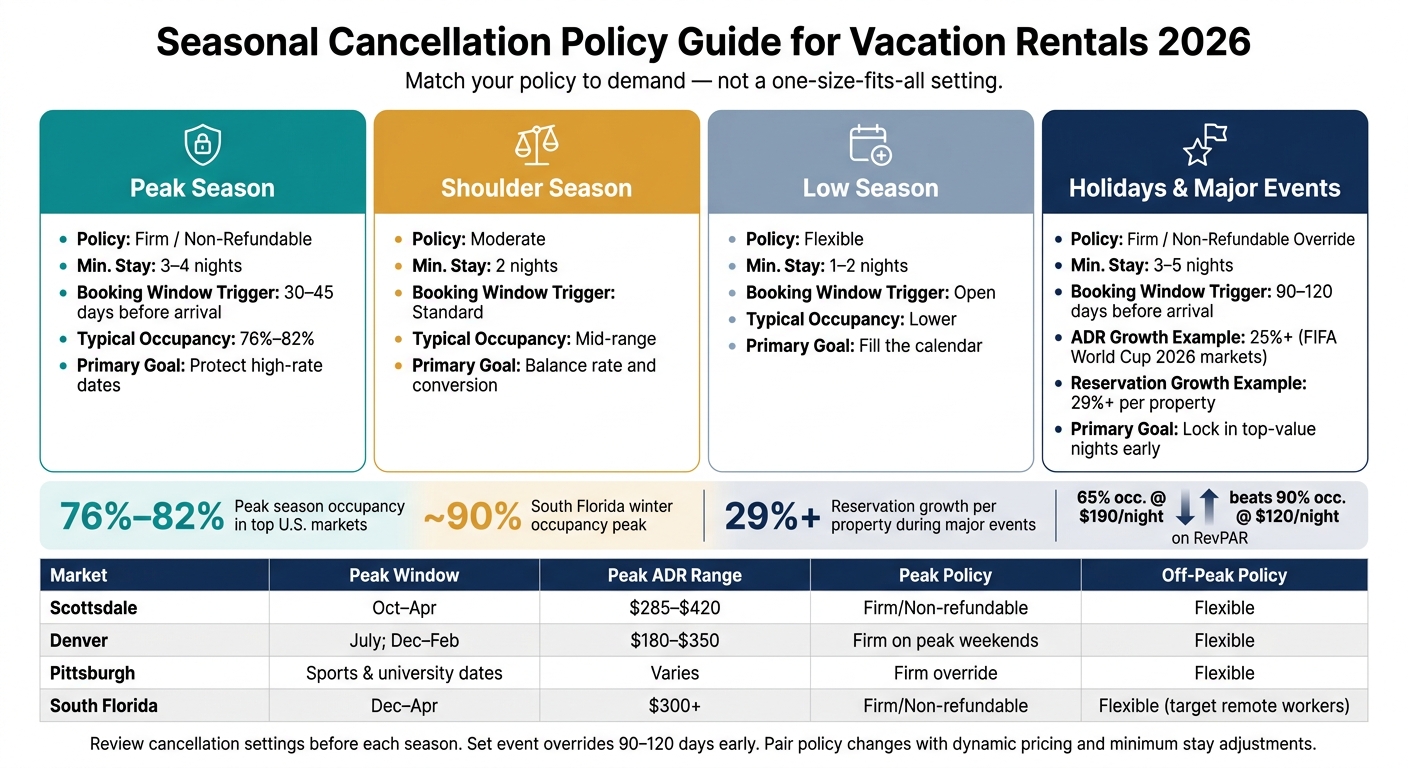
Seasonal Cancellation Policy Guide for Vacation Rentals 2026
Why Most Hosts Have the WRONG Cancellation Policy
Quick comparison
| Period | Best policy direction | Min. stay | Main focus |
|---|---|---|---|
| Peak season | Firm / Non-refundable | 3–4 nights | Protect higher revenue dates |
| Shoulder season | Moderate | 2 nights | Balance conversion and risk |
| Low season | Flexible | 1–2 nights | Fill the calendar |
| Holidays / events | Firm / Non-refundable override | 3–5 nights | Lock in top-value nights |
The market examples follow the same pattern, but the timing changes:
- Scottsdale: tighter terms in winter and spring event months
- Denver: tighter terms for summer weekends and ski-season demand
- Pittsburgh: strict overrides for sports and university dates
- South Florida: stricter winter terms, looser fall terms due to softer demand and storm season
Bottom line: I’d treat cancellation rules like a revenue setting, not a one-time platform setting. Review them before each season, set event overrides early, and check whether the policy is helping revenue – not just occupancy.
How to Set Cancellation Rules by Season
Use one simple rule: make your cancellation policy as strict as your odds of rebooking. If demand is strong and your calendar fills fast, stricter terms help protect income. If demand is slow and bookings are harder to replace, flexible terms can help more guests say yes. Start with the season, then fine-tune by market.
Peak Season: Protect High-Rate Dates with Stricter Terms
Peak season is where late cancellations sting. If someone cancels two days before a busy weekend, you may not have enough time to fill those nights at the same rate.
During peak periods, use a Firm / Non-refundable policy and set a 3–4 night minimum stay starting 30–45 days before arrival. That helps stop one-night bookings from taking up space that could have gone to a higher-paying multi-night stay. You can also offer a non-refundable discount to guests who are ready to commit early.
Peak summer and ski months often post occupancy between 76% and 82% [2]. That tells you rebooking can happen. But timing matters. A stricter policy gives you more room to recover if a guest cancels late.
Shoulder and Low Season: Use Flexible Terms to Keep Calendars Full
Shoulder season usually works best with a Moderate policy and a 2-night minimum. Demand is there, but not strong enough to handle the drag that comes with tougher terms. In these months, couples and remote workers tend to compare options more closely, so rigid cancellation rules can hurt conversion.
Low season is a different game. At that point, the goal is less about defending rate and more about occupancy. Cut your minimum stay to 1–2 nights and switch to a Flexible policy. This is also a smart time to go after longer bookings, like 14+ night stays or even 30–90 day mid-term stays. Those stays can lower turnover costs and help smooth income when short-term leisure demand is thin [1][5].
The best setup here is flexible cancellation terms paired with dynamic pricing, not flat discounts. That same logic also needs to match local demand patterns.
Holiday and Event Dates: Override Your Default Policy
Holidays and major event dates need their own rules. A single cancellation on one of those nights can wipe out a big chunk of booking income.
Take the FIFA World Cup 2026. In host markets, it drove more than 29% growth in reservations per property, and ADR growth topped 25% [1]. Guests coming for events like this often book 90–120 days in advance, so your stricter override needs to be live well before that booking window opens.
A practical move is to flag your top 10–20 highest-value dates each year and apply a Firm / Non-refundable override just to those dates. That way, your main seasonal policy can stay Moderate or Flexible, while the override handles the high-stakes nights.
| Period | Recommended Policy | Min. Stay | Primary Goal |
|---|---|---|---|
| Peak Season | Firm / Non-refundable | 3–4 nights | Protect high-rate dates |
| Shoulder Season | Moderate | 2 nights | Balance rate and conversion |
| Low Season | Flexible | 1–2 nights | Fill the calendar |
| Major Events / Holidays | Firm / Non-refundable | 3–5 nights | Lock in revenue early |
Those same rules won’t play out the same way in Scottsdale, Denver, Pittsburgh, and South Florida.
sbb-itb-103bddb
Market Examples: Scottsdale, Denver, Pittsburgh, and South Florida
These four markets show a simple truth: the same seasonal playbook won’t work the same way everywhere. In some places, demand jumps because of big events. In others, weather or migration patterns do the heavy lifting.
Scottsdale and Denver: Event-Driven Peaks and Weather-Based Demand Shifts
Scottsdale runs on a long winter peak from October through April. That’s when snowbirds arrive, golf travel picks up, and spring events like the Waste Management Phoenix Open and MLB Spring Training tighten inventory. In luxury zip codes 85251–85262, ADR lands between $285 and $420, with occupancy between 75% and 82% during that stretch [5]. Once that peak passes, it makes sense to switch to Flexible terms to keep slower dates moving. In the West Valley, off-season properties average $160–$260 [5].
Denver has a different rhythm. It gets two clear peaks: summer, especially July, when Red Rocks concerts and convention traffic fill the market, and December through February, when ski-proximity demand kicks in. Denver ranks as the 3rd highest occupancy market in the contiguous U.S., with citywide occupancy between 65% and 72% and peak-season occupancy hitting 76% to 82% [2]. LoDo properties average $180–$350 in peak periods [4]. A good approach here is to use Flexible terms with a 1–2 night minimum for March–April and September–October shoulder gaps, then tighten weekend terms during summer concert dates, winter ski season, and convention peaks.
These markets tend to reward stricter terms on top dates and more room to book during shoulder periods.
Pittsburgh and South Florida: Sports, Snowbirds, and Low-Season Risk
Sports-heavy markets and snowbird markets run on almost opposite calendars.
Pittsburgh is driven by sports and universities, which means demand spikes are narrow but easy to spot. The move is pretty direct: flag sports and university dates early, use a Firm override with a 3–4 night minimum 30–45 days out [1], and then switch back to Flexible terms with a 1–2 night minimum when demand cools off.
South Florida flips that pattern. Winter is the high-earning season, with snowbird demand from December through April pushing occupancy close to 90% in some submarkets [6]. Average nightly rates also climb from about $180 in the fall to more than $300 during peak holidays and spring break [6]. That’s the window for Firm or Non-refundable terms, especially if you want to protect longer stays. Fall is a different story. Hurricane risk goes up, leisure demand softens, and Flexible terms paired with a 1–2 night minimum can help pull in remote workers.
Use the table below to match each market’s demand pattern to the right cancellation setup.
| Market | Peak Window | Peak ADR Range | Policy Move | Minimum Stay | Off-Peak Move |
|---|---|---|---|---|---|
| Scottsdale | Oct–Apr | $285–$420 [5] | Firm / Non-refundable | 3–4 nights | Flexible; 1–2 night minimum |
| Denver | July; Dec–Feb | $180–$350 (LoDo) [4] | Firm on peak weekends | 3–4 nights | Flexible; 1–2 night minimum |
| Pittsburgh | Sports and university dates | Sports and university dates | Firm override | 3–4 nights | Flexible; 1–2 night minimum |
| South Florida | Dec–Apr | $300+ [6] | Firm / Non-refundable | 3–5 nights | Flexible in fall; target remote workers |
Implementation Playbook and Revenue Tradeoffs
A Simple Annual Setup Process for One Property or a Portfolio
Use the seasonal rules above as a calendar workflow, not a set-it-and-forget-it setting. Start with your highest-value dates, then build cancellation rules around them. Put stricter overrides in place before your booking window opens.
If a weekend sells out more than 30 days in advance, tighten the policy. If more than 20% of the calendar is still open within 14 days, loosen it.
Check the calendar weekly for pacing and single-night gaps. Review it monthly for RevPAR. Then look at it quarterly to reset cancellation terms by season.
Once your calendar is in place, the next step is simple: figure out what each policy costs you in conversion and protection.
Revenue Tradeoffs by Policy Type, Season, and Management Approach
A policy doesn’t work on its own. Pricing and minimum stays need to move with it. The table below shows what each policy type tends to look like across demand periods.
| Season | Recommended Policy | Booking Conversion | Cancellation Risk | Revenue Protection |
|---|---|---|---|---|
| Peak | Strict / Non-refundable | Lower (some friction) | Low | High |
| Shoulder | Moderate | Medium | Medium | Medium |
| Low | Flexible | High | High | Low – depends on rebooking speed |
| Holiday / Event | Stricter override | Lower | Very low | Very high |
One tactic worth testing: offer your standard policy at the base rate and a fully flexible policy at a 10–15% premium [1]. Guests who want last-minute cancellation often pay extra for it. That added amount helps cover some of the rebooking risk if they cancel.
The management side matters too. A policy on paper is one thing. Running it across channels, dates, and demand shifts is another.
| Factor | DIY Management | Professional Management |
|---|---|---|
| Time required | 15–20 hours/week for a portfolio [4] | Minimal – owner oversight only |
| Pricing execution | Often manual or static | Dynamic pricing and calendar updates [1][5] |
| Average occupancy | ~58% [3] | ~75% [3] |
| Data tracking | Basic (Airbnb Insights) | Market dashboards, pacing data [3] |
| Policy updates across channels | Manual, easy to miss | Coordinated across Airbnb and Vrbo |
Execution speed is what separates a decent policy from one that makes money.
When Professional Management Improves Cancellation Strategy Execution
The main edge of professional management is speed. Policy changes, pricing shifts, and channel updates happen at the same time. Most self-managing owners don’t struggle with ideas. They struggle with follow-through.
That’s where things tend to break down:
- Updating settings across Airbnb and Vrbo every time a new high-demand event pops up
- Matching policy changes with pricing updates
- Tracking whether stricter terms are protecting revenue or just cutting bookings
Execution matters more than strategy: policy changes, pricing updates, and channel coordination must happen fast.
Rank One Stays handles policy coordination, pricing, guest support, housekeeping, and damage claims for owners in Scottsdale, Denver, Pittsburgh, and Lighthouse Point, with fees starting at 10%. Properties managed by Rank One Stays earn 38% more revenue than the market average, and broader industry data shows professional management can lift revenue 30% to 50% versus DIY efforts [2]. Rank One Stays gives owners one system for seasonal policy, pricing, and operations.
Conclusion: Build a Seasonal Policy Calendar That Protects Revenue
A one-size-fits-all policy all year long leaves money on the table. Seasonal rules help you protect your rate during peak periods and improve conversion when demand slows down.
That idea plays out a little differently in each market. Scottsdale, Denver, Pittsburgh, and South Florida all need seasonal overrides, but the peak season doesn’t hit at the same time in each one.
The good news is that this can be handled with a simple annual review process. Review demand before each season, set holiday and event overrides early, and reset terms as the booking window changes. Do that month after month, and your calendar starts working like a revenue tool instead of just a settings page.
Once the calendar is set, execution is what separates average results from strong ones. If you want help putting that calendar into action, Rank One Stays offers full-service vacation rental management in Scottsdale, Denver, Pittsburgh, and South Florida. Property owners partnering with Rank One Stays earn 38% more revenue than the market average, with fees starting at 10%.
FAQs
How often should I change my cancellation policy?
Adjust your cancellation policy at least once each season so it lines up with shifts in demand, especially across peak, shoulder, and low seasons.
During high-demand stretches, like peak season in Scottsdale or Denver, stricter terms can help protect your revenue. When demand cools in shoulder or low seasons, looser terms can help you stay competitive and bring in more bookings.
How do I choose between Firm and Non-refundable?
Choose based on market demand and seasonality. A Firm policy strikes a balance between guest flexibility and revenue protection, while Non-refundable gives you the most protection against vacant nights but can reduce conversion.
For the best results, match your cancellation policy to your property’s market conditions.
What metrics should I track besides occupancy?
Besides occupancy, focus on RevPAN or RevPAR to judge actual revenue performance. These metrics combine your nightly rate with how often your calendar is booked, which gives you a clearer picture than occupancy alone.
You should also track a few other numbers that tell you what’s working and what needs attention:
- ADR for pricing power
- Conversion rate for booking effectiveness
- Booking lead time to help anticipate demand
- Average length of stay to help cut turnover and operating costs
Each one tells part of the story. Put them together, and you get a much sharper view of how your property is performing day to day.