
Most denied short-term rental claims don’t fail because a host had no policy. They fail because of exclusions.
If I were skimming this before buying coverage, I’d focus on seven gaps first: guest-caused damage, wear and tear, pests and mold, flood and water backup, vacancy limits, misstatements on the policy, and off-platform bookings. The article’s point is simple: a policy can look broad on the quote page and still leave you paying out of pocket when the loss falls into one of these carve-outs.
Here’s the short version:
- Standard homeowners insurance often denies claims tied to paid guest stays.
- Platform protection usually applies only to bookings made on that platform.
- STR insurance is built for hosting, but it can still have caps, waiting periods, and carve-outs.
- Water losses often hinge on where the water came from.
- Mold, pests, and slow leaks are often treated as maintenance, not insured damage.
- A home left empty for 30 to 60 days may face reduced coverage.
- If STR use wasn’t disclosed, a carrier may void coverage or deny the claim.
- Direct bookings can leave you with $0 platform protection.
A few numbers stand out: water backup endorsements may cost about $30 to $250 per year; flood coverage can run about $400 to $3,000+ per year; some mold jobs can top $10,000; and some STR policies fall in the $500 to $1,500 per year range, though some markets cost much more.
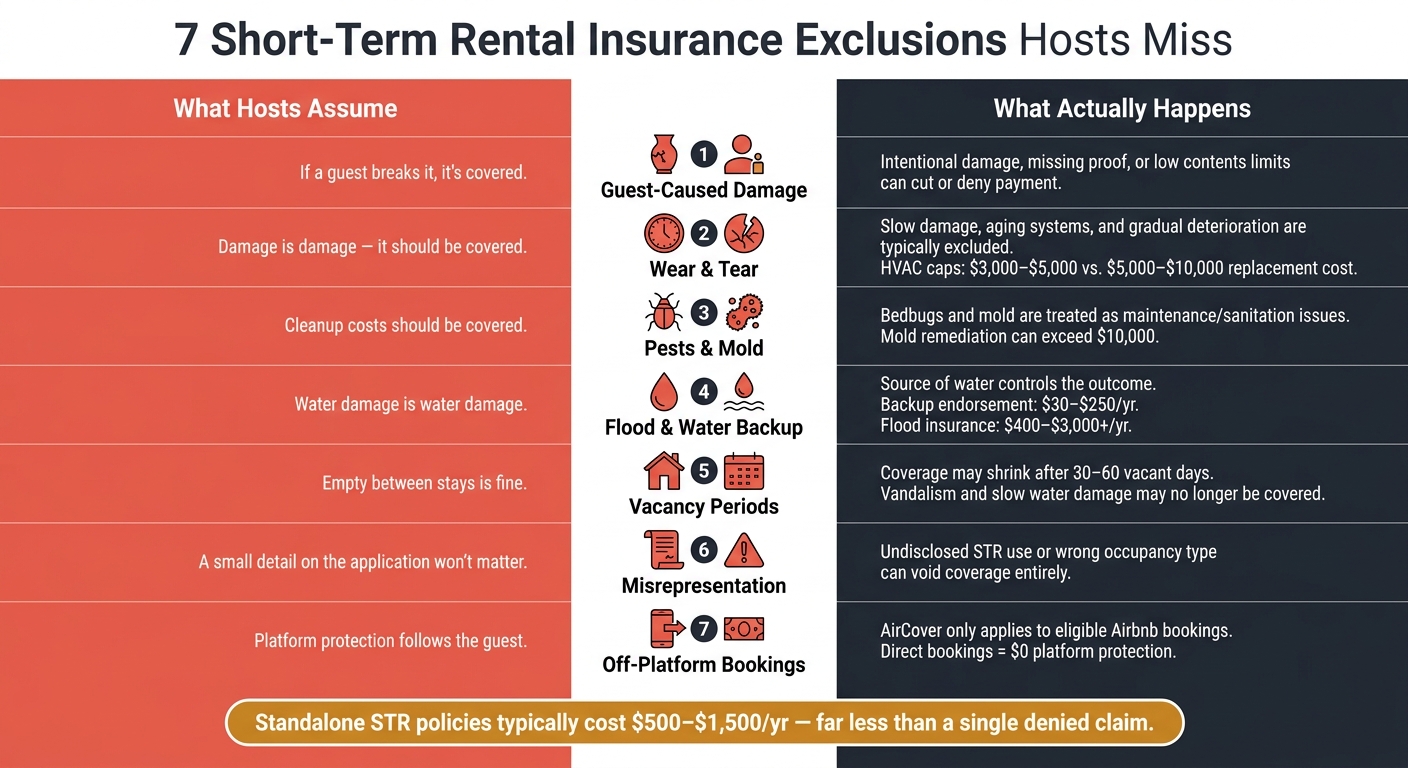
7 Short-Term Rental Insurance Exclusions: What Hosts Assume vs. Reality
Your Short-Term Rental Insurance Policy Has Gaps You Don’t Know About – We Proved It Live
sbb-itb-103bddb
Quick Comparison
| Gap | What hosts often assume | What often happens |
|---|---|---|
| Guest damage | “If a guest breaks it, it’s covered.” | Intentional damage, missing proof, or low contents limits can cut payment |
| Wear and tear | “Damage is damage.” | Slow damage and old systems are often excluded |
| Pests and mold | “Cleanup should be covered.” | Bedbugs, mold, and infestation are often treated as upkeep |
| Flood and backup | “Water damage is covered.” | Source of water controls the claim result |
| Vacancy | “Empty between stays is fine.” | Coverage may shrink after 30–60 days empty |
| Misstatements | “A small detail on the application won’t matter.” | Wrong occupancy or missing STR disclosure can sink a claim |
| Off-platform bookings | “Platform protection follows the guest.” | It usually stops once the booking is made elsewhere |
Bottom line: I’d read the exclusions, vacancy wording, booking-channel rules, and income-loss terms before I looked at price.
Why Short-Term Rental Policies Have More Gaps Than Hosts Expect
Insurers pay claims based on how a loss lines up with the policy. And that comes down to definitions.
Words like "sudden and accidental," "covered perils," "vacancy," "business use," and "intentional acts" may sound like small print, but they often decide how much gets paid – or whether anything gets paid at all. That’s why the next seven exclusions matter so much.
One of the biggest trouble spots is the commercial-use exclusion. Standard homeowners and renters policies are built for personal occupancy, not paying guests. So when a host files a short-term rental claim under a personal policy, denial is common.
AirCover can help with eligible Airbnb bookings, but it has limits. It is not a full insurance policy, and it does not apply to Vrbo or direct bookings [4].
There’s another layer, too: local rules may require separate liability minimums for short-term rentals. So the summary page doesn’t tell the whole story. The terms that matter most usually sit in the fine print – exclusions, sublimits, endorsements, and booking rules. Those details often decide whether a claim gets paid at all.
The first trap is guest-caused damage, where intent and policy limits often shape the payout.
1. Guest-Caused Damage Limits and Intentional Acts
What It Excludes
A lot of hosts assume guest damage is covered by default. In many cases, that’s just not true.
Even when a policy allows STR use, claims tied to guest damage can still run into exclusions, lower payout caps, and strict proof rules. So yes, STR activity may be allowed on paper, but that doesn’t mean every broken item or damaged room gets paid for.
How Denied or Reduced Claim Payouts Happen
Claims often get cut down or denied when the damage looks intentional or when unapproved guests were involved. Insurers can also push back if you can’t show clear evidence of the home’s condition before and after the stay.
Dated photos matter here. Without before-and-after documentation, an insurer may say the damage was already there and treat it as pre-existing. Even if the policy permits STR use, the payout may still depend on whether the damage was accidental and well documented.
Policy Terms Hosts Should Verify Before Buying
Before you buy, make sure the policy says STR use is covered in plain terms. Don’t assume “rental” means short stays.
It also helps to check:
- How the policy handles guest-caused damage
- Whether contents limits are much lower than dwelling limits
- What proof the insurer wants when you file a claim
Coverage to Ask For
If you host once in a while, ask about a short-term rental endorsement. If bookings are frequent, a standalone STR policy may make more sense.
There’s another line hosts should pay attention to: routine deterioration. Insurers usually treat that as wear and tear, not sudden damage, which means it usually won’t be covered.
2. Wear and Tear, Gradual Deterioration, and Maintenance Issues
Once damage starts to look slow, expected, or tied to age, insurers often shift it out of guest damage and into maintenance.
What the Exclusion Typically Removes from Coverage
Wear-and-tear claims usually get denied for a simple reason: insurers cover sudden loss, not gradual breakdown.
So things like scratched flooring, chipped paint, worn carpets, and mechanical failures from normal use are usually treated as routine upkeep, not covered damage.
How Denied or Reduced Claim Payouts Happen
This is where many hosts get stuck. If the damage appears gradual, insurers often say it falls outside coverage. That can include slow leaks, sediment buildup, or mold caused by hidden moisture.
They may also ask for maintenance records. If you don’t have them, the insurer may label the loss as excluded deterioration instead of a covered event. The same issue comes up if you can’t show regular upkeep, such as professional cleaning, maintenance, and repairs within the past 12 months [8].
Coverage caps can also leave you paying the difference. HVAC replacement can cost $5,000 to $10,000, but many plans cap HVAC coverage at $3,000 to $5,000 [8]. If your system costs more than the cap, that extra amount comes out of your pocket.
Policy Terms Hosts Should Verify Before Buying
Before you buy, read the policy’s sudden and accidental language. If the policy only covers sudden events, gradual deterioration is usually excluded by default.
It also helps to check sub-limits. HVAC and appliance caps often fall below the full replacement cost, which can turn a paid claim into a partial payout.
Then look for any pre-existing condition clause. Some insurers treat a failure that shows up within the first 30 days of coverage as a sign that the problem started before the policy took effect [8].
The next exclusion is just as common: pest and infestation damage, which insurers often treat as upkeep rather than a covered loss.
3. Pest, Bedbug, Mold, and Infestation Damage
Unlike wear-and-tear claims, pest and mold losses often get denied for a different reason: insurers put them in the infestation or cleanup bucket. In plain English, that means pest, bedbug, and mold claims are often treated as sanitation or upkeep issues, not sudden property damage.
What the Exclusion Typically Removes from Coverage
Most policies exclude mold linked to slow leaks, poor ventilation, or delayed cleanup. Many also treat bed bugs as pests, not covered damage [7][9].
How Denied or Reduced Claim Payouts Happen
A lot of denials come down to timing and proof. If the insurer finds past complaints about dampness, musty odors, or pests – and no one dealt with the problem – the carrier may deny the claim based on negligence [7][9].
That can get expensive fast. Mold can begin to colonize within 24 to 48 hours when indoor humidity stays above 60% [7]. Professional mold remediation can easily top $10,000, especially if drywall and insulation have to be removed. On top of that, hosts may lose rental income while the property sits vacant during cleanup [7].
Policy Terms Hosts Should Verify Before Buying
Two clauses matter most:
- "Gradual seepage" language – If the policy excludes mold caused by slow leaks or seepage, many day-to-day mold claims likely won’t qualify [7].
- "Loss of Business Income" coverage – Check that it applies when the property is uninhabitable during remediation [4].
Coverage to Ask About
Ask whether the policy offers a bed bug endorsement and loss-of-income coverage during remediation downtime. Some protection programs cap bed bug remediation coverage at $15,000 [6].
Flood claims turn on the source of the water, not just the damage.
4. Flood, Surface Water, and Water Backup Losses
This exclusion often picks up where the last one leaves off: a small leak turns into a much bigger water claim.
What matters most is where the water came from. A burst pipe, a drain backup, and flooding from outside may all leave behind soaked floors and damaged walls. But insurers usually treat them as different types of losses. That’s where many hosts get tripped up. Policies tend to sort water claims by source, not by how bad the damage looks.
What the Exclusion Typically Removes from Coverage
Standard policies usually leave out sewer and drain backups, sump pump failure, surface water, and storm surge. Groundwater that pushes through foundation walls is also generally excluded [10][11].
Here’s the split in plain English:
- A burst washing machine hose is usually covered.
- Water forced up through a floor drain during a heavy rainstorm usually is not covered unless you added an endorsement [11].
Same mess. Different source. Very different claim result.
How Denied or Reduced Claim Payouts Happen
Timing can make or break this kind of claim. Many policies exclude water damage once a leak or seepage has been active for more than 14 days [12]. So if the insurer says the loss was seepage instead of a sudden event, the claim may be denied [10][11].
There’s another detail that catches people off guard. A backup endorsement usually pays for cleanup and repairs after sump pump failure, but not the cost to replace the pump itself [11].
Policy Terms Hosts Should Verify Before Buying
Two terms deserve a close look before you buy:
- "Sudden and accidental" language – Make sure the policy covers backup events that happen without warning, not just gradual seepage [11][7].
- Water damage during a guest stay – Some standard homeowners policies can deny water damage claims altogether if the loss happens during a short-term rental stay [3].
It’s also smart to check for an "Access" clause. This can help pay to tear out concrete slabs or flooring so a failed pipe can be reached [12].
Possible Endorsements or Separate Coverage to Consider
A water backup and sump overflow endorsement can close much of this gap. It typically costs $30 to $250 per year and often comes with limits of $5,000 to $25,000 [10][11]. Flood insurance through the NFIP or a private carrier usually runs $400 to $3,000+ per year, depending on the flood zone [11].
| Coverage Type | What It Covers | Typical Annual Cost | Typical Limit |
|---|---|---|---|
| Water/Sewer Backup Endorsement | Drain and sewer backups, sump pump failures | $30–$250 [10][11] | $5,000–$25,000 [11] |
| Flood Insurance (NFIP or Private) | Rising surface water, storm surge, mudflow | $400–$3,000+ [11] | Up to $250,000 (structure) / $100,000 (contents) [11] |
One more thing: water backup coverage usually stops at the home’s foundation. If the underground sewer line itself needs repair, that usually falls under a separate service line endorsement [10][6].
A backwater valve or a sump pump battery backup can help cut the odds of a backup and make your claim file stronger. Without the right endorsements, many hosts find out too late that flood losses and backup losses sit in two separate holes in the policy.
5. Vacancy, Unoccupied Property, and Habitability Limits
Short-term rentals aren’t booked all 365 days of the year. And those quiet stretches between guests? That’s often where policy limits start to bite. A vacancy clause can kick in even between bookings if the property sits empty for too long.
What the Exclusion Typically Removes from Coverage
Many standard homeowners policies have a vacancy clause that limits coverage after a home sits empty for a set stretch, often 30 to 60 days [7]. Once that clock runs out, losses tied to vandalism and slow water damage may no longer be covered. Even a gap between guest stays can trigger those rules, especially if no one is stopping by to check the place, a service often included with professional vacation rental management.
There’s also a habitability limit that catches a lot of hosts off guard. If mold shows up during a vacancy, the insurer may treat it as a maintenance problem instead of a covered loss [7].
How Denied or Reduced Claim Payouts Happen
An empty home can turn into a problem faster than people think. Stale air and trapped moisture can create the kind of conditions mold loves. If mold appears during a vacant stretch, insurers often label it gradual damage rather than a covered event. And if that mold makes the home uninhabitable, repairs can drag on for weeks while lost rent is often left out [7].
That gets expensive fast. Mold cleanup can cost thousands to tens of thousands of dollars [7].
Policy Checks
A few policy details matter here:
- Check how many consecutive days the property can sit empty before coverage changes [7].
- Confirm whether your policy includes loss of income protection if a covered peril makes the home uninhabitable [1].
Possible Endorsements or Separate Coverage to Consider
A standalone short-term rental policy is built for commercial hosting and usually includes loss of income coverage that standard homeowners policies often leave out [1]. These policies usually cost $500 to $1,500 per year, though premiums in higher-risk markets like Florida or California can climb to $9,000 per year [1][2].
Smart humidity and leak sensors can also help spot trouble during vacant periods before it turns into an uninsured mess. Basic setups usually run $150 to $320 [3].
Vacancy gaps can also create disclosure problems, which leads into fraud and misrepresentation exclusions.
6. Fraud, Misrepresentation, and Policy Violations
This exclusion comes into play when the policy application, property use, lease terms, or permits don’t line up with how the home is actually being used.
What the Exclusion Typically Removes from Coverage
If you don’t disclose short-term rental use, the insurer may have a clear path to deny the claim. Saying the home is a primary residence, or leaving out STR use, can void coverage [3].
How Denied or Reduced Claim Payouts Happen
Insurers dig into claims closely. If there’s a gap between what you put on the application and how you run the property day to day, that gap can be enough for a denial. The core issue is simple: did you disclose the property’s actual use?
Rental arbitrage hosts have one more problem to watch for. Many standard leases ban subletting for STR use, and hosting without written permission can lead to eviction and denied coverage [1][3]. If you’re leasing the property, get a written addendum that clearly allows STR use.
Policy Terms Hosts Should Verify Before Buying
Before you buy a policy, make sure it clearly covers STR use, not just occasional personal use. If you only host from time to time, check whether the insurer offers:
- a short-term rental endorsement
- a commercial-use endorsement
- a standalone STR policy [1]
You should also confirm that the policy meets local liability rules. Denver, for example, requires at least $500,000 in liability coverage per occurrence for STR operators [5].
If the booking source itself falls outside policy rules, the next claim issue can be even worse.
Possible Endorsements or Separate Coverage to Consider
A standalone STR policy usually costs $500 to $1,500 per year [1]. It’s written around the property’s actual use instead of assuming the home is only owner-occupied.
Even if the policy details are correct, coverage can still fall apart when the booking came from a source the insurer doesn’t approve.
7. Off-Platform Bookings and Third-Party Reservation Gaps
Even if your policy disclosure is flawless, there’s still another problem: the booking source itself.
Platform protection only applies to bookings made on that platform. So if a guest books direct, through your own site, or through another channel, you may be dealing with a gap in coverage. And that gap can get painful fast. Standard homeowners or renters policies often leave out short-term rental use. That becomes a big issue when a guest gets hurt or damages the property and the insurer starts asking where the reservation came from.
What Off-Platform Bookings Leave Uncovered
AirCover includes up to $3 million in host liability insurance and $3 million in damage protection, but only for eligible Airbnb bookings [4]. If the stay was booked off-platform, that protection stops there.
How Denied or Reduced Claim Payouts Happen
A lot of denied claims come down to paperwork. Insurers may ask for proof of who stayed at the property, how the booking was made, and what terms were in place. If there’s no signed rental agreement or no guest-screening record, the payout may be cut or denied [3].
Policy Terms Hosts Should Verify Before Buying
Before you take direct or third-party bookings, look for policy language that clearly covers "short-term rental use." If you list on more than one channel, make sure the policy applies to all booking sources, not just one platform [4].
Possible Endorsements or Separate Coverage to Consider
A standalone STR policy can cover guest injuries, theft, and loss of rental income across all booking sources [1][4]. Some insurers also offer a limited endorsement for off-platform stays, but you have to read the terms closely. The easiest way to spot a gap is to line up each booking channel against the policy language and see where coverage starts – and where it doesn’t.
Coverage Gap Reference Table
Use this table to see where each policy type stops paying. That matters more than most hosts think, because the gap usually shows up after the damage happens.
| Exclusion | What’s Typically Not Covered | Common Claim Scenario | Typical Claim Result | What to Check in Your Policy |
|---|---|---|---|---|
| Guest-Caused Damage & Intentional Acts | Cash, certain valuables, and intentional vandalism | Guest theft or intentional vandalism | AirCover: limited or no coverage for cash and valuables [1]. Standalone STR: may cover guest theft [1]. Standard HO: often denied because of commercial-use exclusions [1][3] | "Theft by guest" exclusions; "mysterious disappearance" language |
| Wear and Tear / Deterioration | Mechanical failure, gradual damage, and aging appliances | HVAC fails after years of use | Usually not covered | Wear-and-tear exclusion; consider a home warranty as a supplement |
| Pest and Bedbug Infestation | Bedbug remediation, treatment costs, and some closure-related losses | Guest brings bedbugs | Standard HO: typically $0. AirCover: limited or slow reimbursement [1]. Standalone STR: often includes remediation and loss of income [1][4] | "Remediation" sublimits; "Loss of Use" coverage during closure |
| Flood & Water Backup | Sewer backups and sump pump failure without an endorsement | Heavy rain causes sump overflow | Standard HO and some STR policies: often $0 without a water-backup endorsement [8] | How the policy defines "flood" versus "water damage"; water-backup endorsement |
| Vacancy & Unoccupied Periods | Damage during extended empty periods | Pipe bursts during a long vacancy | Standard HO: often denied under vacancy clauses. Standalone STR: usually covered [8] | Vacancy and unoccupancy definitions |
| Fraud & Misrepresentation | Claims tied to inaccurate disclosures about use or occupancy | Host misstates property use | Claims can be denied; coverage may be voided. [3] | Disclosure requirements; primary-residence rules; written permission for rental arbitrage [3][5] |
| Off-Platform Bookings | Any stay not booked through the platform providing protection | Guest books direct and causes damage | AirCover: $0 [4]. Standard HO: often denied [1]. Standalone STR: can cover across booking channels [1][4] | Coverage that applies across booking channels; multi-platform endorsement |
The pattern is pretty clear. Standard homeowners policies usually exclude commercial STR use, AirCover only applies to eligible platform bookings, and a standalone STR policy is broader.
That is still modest compared with a denied major claim.
Before you buy, check if your policy language closes these gaps.
What to Check Before Buying Short-Term Rental Insurance
Policy type matters. But the fine print is what tells you what’s actually covered.
Before you buy, go line by line and test the policy against the exclusions above. That’s where gaps tend to show up.
Check these items first:
- Guest-caused damage: Confirm whether damage from guest theft or intentional acts is covered or excluded. Also verify whether the policy includes liability coverage for guest injuries.
- Wear and tear, mold, and pests: See whether an endorsement extends coverage to gradual damage, mold, or infestation-related losses.
- Vacancy threshold: Confirm the maximum number of vacant days allowed and make sure coverage stays in place during gaps between bookings.
- STR-use disclosure and commercial-use exclusion: Make sure your short-term rental use is fully disclosed and that the policy terms match that use. Failing to disclose commercial use can void coverage [13].
- Booking channels: Get written confirmation that coverage applies to Airbnb, Vrbo, and direct bookings.
- Liability limit: Verify the liability limit in writing. Denver, for example, requires at least $500,000 in liability coverage per occurrence for STR use [5].
- Loss of rental income: Confirm that the policy pays for lost income if the property becomes uninhabitable because of a covered loss [1][4].
Booking source matters just as much as vacancy rules and disclosure. A policy that works for Airbnb bookings but leaves out direct bookings can leave you in a bad spot.
If you manage a property from afar, Rank One Stays can help you keep the condition records, photos, and other documentation insurers often want during a claim. Good records can make the difference between a claim that drags and one that gets paid.
Remote hosts should also keep up-to-date photos, maintenance logs, and clean records to back up any future claim.
How Professional Management Can Help Hosts Avoid Insurance Mistakes
Once you know what a policy leaves out, the next job is simple in theory and easy to miss in practice: keep the records that show a claim should be covered. That’s where professional management helps. Good managers cut down on claim denials by keeping the paperwork, photos, and guest records insurers often ask for.
Rank One Stays handles guest communication, housekeeping, maintenance coordination, and damage claims. That kind of support matters most when an owner needs proof of the property’s condition before check-in.
Managers often use photo-based cleaning checklists before each stay to build a clear record of condition. If damage shows up, they can file claims soon after it’s found, which helps owners meet reporting windows before the next guest arrives [15].
Pre-arrival inspections help in another way too. If HVAC equipment or smart locks fail during a check, managers can create maintenance tickets automatically. That makes it easier to separate covered damage from ordinary wear and tear [15].
They can also keep records that matter when a guest breaks the rules. Guest logs, plus noise monitors or cameras, can show unauthorized guests or pets. That creates an audit trail that supports policy-violation and fraud exclusion defenses [15][5][3].
There’s also the licensing side. Insurance risk goes up fast when local compliance slips. An active STR license is often required, and missing permits can void claims [14][5]. A management team that tracks local permit rules and habitability standards helps lower that risk.
Conclusion
A low premium doesn’t always mean a better deal. If the policy leaves out water backup, guest damage, or tight sublimits, you could still end up paying a lot out of pocket.
Before you buy, check the exclusions, sublimits, and booking rules. Also ask how claims are valued. Replacement cost and actual cash value can differ by thousands of dollars on the same loss [8].
The fine print is where many claims fall apart. Commercial-use limits, booking-source gaps, and maintenance-related wording show up more often than many hosts think.
Start with the exclusions. Then decide if the policy price lines up with the coverage.
FAQs
Do I need STR insurance if I already have homeowners insurance?
Yes. Standard homeowners insurance often excludes short-term rental activity. That means a claim tied to a guest injury or property damage could be denied.
Host protection programs from booking platforms may help, but they don’t always cover everything. Rank One Stays can help manage damage claims and guest safety. Even so, you should check your policy and confirm any local liability coverage rules.
What endorsements should hosts add for water, mold, or vacancy risks?
Hosts should check that their short-term rental policy includes endorsements for water damage, mold remediation, and vacant periods.
Here’s why that matters: standard homeowners insurance often leaves gaps. It may exclude these risks altogether or cap claims tied to slow leaks, maintenance-related mold, or homes left empty for longer stretches.
It’s also smart to confirm the policy stays active between bookings. Some plans can void coverage during longer vacant periods, which can turn a small issue into a big out-of-pocket cost.
Are direct and off-platform bookings covered the same way as Airbnb stays?
No. Platform protections like Airbnb’s AirCover usually apply only to stays booked through that platform.
If you take direct or off-platform bookings, those stays usually fall outside that protection. That means you may need a dedicated short-term rental insurance policy.
And there’s another catch: standard homeowners insurance often excludes commercial rental activity. So if you’re renting out your place for income, a basic home policy may not cover the gaps you think it does.